
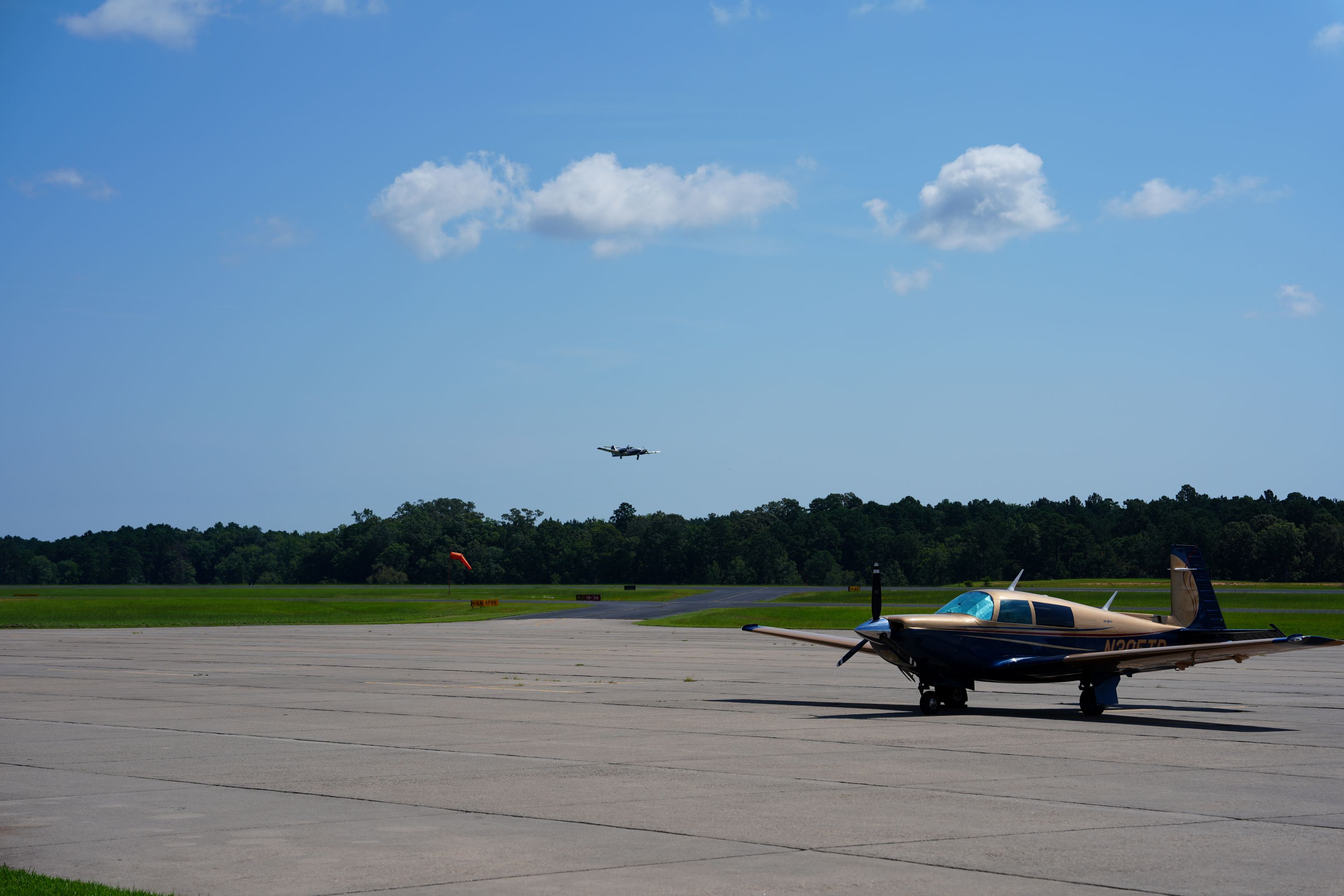
A short-field landing is not simply a normal landing with harder braking. The current FAA Private Pilot Airman Certification Standards evaluate the entire sequence: runway selection, a stabilized approach, aircraft-specific airspeed and configuration, wind correction, touchdown accuracy, alignment, minimum float, and the manufacturer's braking procedure. The touchdown standard for the private-pilot task is on the specified point or within 200 feet beyond it.
Standards note: The tolerances below come from FAA-S-ACS-6C, Area of Operation IV, Task F. The ACS is the private-pilot practical-test standard. Your airplane's POH/AFM and your instructor determine the aircraft-specific procedure.
What a short-field landing is designed to demonstrate
The maneuver shows whether the pilot can manage the airplane's energy and place it accurately on a limited landing area without sacrificing control. Accuracy begins before the flare. Excess altitude, excess speed, poor wind correction, an unstable descent, or an unsuitable touchdown aim point can make the landing inaccurate even when the final touchdown feels smooth.
The FAA's energy-management framework treats altitude and indicated airspeed as the airplane's primary stored-energy states. A short-field approach therefore depends on arriving at the flare with the correct combination of height, flight path, and airspeed - not merely trying to force the airplane onto a point.
Why pilots really learn this maneuver
Short-field landing training prepares a pilot to use a runway with limited usable distance or obstacles near the landing area while preserving control and the option to go around. The practical skill is not merely touching down close to a point. It is deciding whether runway length, wind, surface, aircraft performance, and pilot capability leave enough margin - and recognizing early when the correct decision is to discontinue the approach.
Operational example: A pilot arrives at a short runway with trees near the threshold and a gusty crosswind. A stable path, the correct aircraft-specific airspeed, minimum float, accurate touchdown, and disciplined braking all matter. If any part cannot be maintained, the safe result is a go-around or diversion.
Current FAA private-pilot standards
Planning
Select a runway and touchdown point considering pilot capability, airplane performance and limitations, available distance, wind, landing surface, and obstructions.
Approach
Establish the recommended configuration, airspeed, and trim. Use pitch and power to maintain a stabilized approach.
Airspeed
Maintain the manufacturer’s published approach airspeed. If none is published, use no more than 1.3 VSO, within +10/-5 knots, with the gust factor applied.
Wind
Maintain directional control and appropriate crosswind correction throughout the approach and landing.
Touchdown
Touch down in the proper pitch attitude on the specified point or within 200 feet beyond it, with no side drift, minimum float, and the longitudinal axis aligned with the runway centerline.
Rollout
Use the manufacturer’s recommended configuration and braking procedures.
Judgment
Plan for a rejected landing or go-around. Discontinue an unsafe or unstable attempt.
The 200-foot tolerance is a touchdown-zone standard, not permission to dive at a point, land flat, skid tires, or sacrifice centerline control. Every other skill and risk-management element still applies.
Key deviations to check in the debrief
The following is not a statistical ranking. Each item is included because it conflicts directly with the FAA task or creates one of the risks identified in it.
1. The approach never became stable
Look for speed, descent rate, configuration, or flight-path changes that continued close to the runway. A touchdown can be inside the 200-foot zone and still reflect an unstable approach.
2. Excess energy produced float
A fast or high approach can carry the airplane beyond the intended touchdown area. The ACS specifically calls for minimum float. Compare the airplane's indicated airspeed, when available, and FlytWERX eIAS with the POH/AFM procedure. GPS groundspeed alone is not airspeed, and any eIAS interpretation depends on the quality of the active wind correction.
3. The pilot chased the point instead of controlling the flight path
Large late pitch or power changes may create an abrupt roundout, a high sink rate, or a balloon. The better question is whether the pilot established a repeatable path to the point.
4. Crosswind correction faded near touchdown
The ACS requires appropriate correction through the approach and landing, with no side drift and the airplane aligned with the centerline at touchdown.
5. Braking began before the airplane was ready
The correct use of braking and configuration is aircraft-specific. The debrief should compare what happened with the current POH/AFM and instructor guidance rather than applying a universal braking recipe.
6. The pilot continued after the landing stopped being salvageable
The ACS includes rejected-landing and go-around planning as a risk-management element. A timely go-around is the correct outcome when the approach or touchdown cannot be completed safely.
A factual data-backed debrief
Flight data should help reconstruct the event. It should not pretend to measure what the sensors did not record.
Data that can help
Depending on the source and installation, a recorded session may help show:
- altitude and vertical path on final;
- heading, course, position, and ground track relative to the runway;
- groundspeed trend;
- pitch and bank trend;
- vertical-speed trend;
- the approximate touchdown location and rollout path.
- FlytWERX estimated indicated airspeed (eIAS), calculated from GPS-derived speed, current winds aloft, temperature, and the active wind correction.
Data that cannot establish by itself
Available telemetry and a calculated eIAS value may not prove:
- the airplane's direct pitot-static indicated airspeed or, by itself, compliance with an ACS airspeed tolerance;
- the exact wind vector at the airplane when local conditions differ from the active wind correction;
- control inputs, rudder coordination, or brake pressure;
- visual scan, runway clearance, or traffic awareness;
- whether the pilot followed the POH/AFM checklist;
- tire side load or the quality of the touchdown feel.
GPS groundspeed must never be relabeled as indicated airspeed. FlytWERX eIAS is a separate calculated estimate that uses GPS and atmospheric inputs. It can strengthen a post-flight review when the wind correction is current, while the airplane's approved airspeed indication remains controlling in flight.
Debrief the landing in seven questions
1. Was the selected runway and touchdown point appropriate? Consider available distance, wind, surface, obstructions, aircraft performance, and pilot capability.
2. When was the approach first stable? Identify the point at which configuration, path, and speed were established.
3. What did the airplane's energy state look like? Was it high, fast, low, slow, or appropriately managed?
4. Where did float begin and end? Compare the flight path with the intended touchdown point.
5. Was alignment and drift control maintained? Use both instructor observation and the available track data.
6. Was the eIAS input current and representative? Confirm the wind source, temperature, update time, and whether more representative winds for the training area were available.
7. What one correction should be carried into the next attempt? Choose a specific, observable action rather than a vague instruction such as "land shorter."
How FlytWERX can support the review
The current FlytWERX app records available telemetry from supported sources such as Stratus, iPhone/iPad sensors, and Microsoft Flight Simulator, including altitude, heading, groundspeed, vertical speed, pitch, bank, course, position, and flight path. For supported live-flight sessions, FlytWERX also calculates eIAS using GPS-derived speed, current winds aloft, temperature, and the active wind correction; the pilot or instructor can enter more representative winds for the training area when available. In routine training comparisons, FlytWERX instructors have generally observed average differences of approximately 1-3 knots between eIAS and the airplane's indicated airspeed when the wind correction is current. That is a first-party field observation, not a certified specification. The airplane's approved airspeed indication remains controlling in flight, and the instructor still determines why a deviation occurred and whether the aircraft-specific procedure was correct.
Frequently asked questions
What is the private-pilot touchdown tolerance for a short-field landing?
FAA-S-ACS-6C requires touchdown on the specified point or within 200 feet beyond it, while also meeting the pitch-attitude, alignment, no-side-drift, minimum-float, and control requirements.
Does the FAA require exactly 1.3 VSO on every short-field approach?
No. The ACS first requires the manufacturer's published approach airspeed. The 1.3 VSO provision applies when the manufacturer has not published an approach airspeed.
Is maximum braking always required?
Use the manufacturer's recommended procedures for configuration and braking. Technique varies by airplane, surface, conditions, and POH/AFM guidance.
Can GPS groundspeed or FlytWERX eIAS prove that the approach met the ACS airspeed tolerance?
GPS groundspeed alone cannot. FlytWERX eIAS is a calculated training estimate that uses GPS-derived speed and atmospheric inputs. It can support maneuver grading and debriefing when the inputs are current, but it is not a direct measurement from the airplane's approved airspeed system and should not be presented as one.
When should a pilot go around from a short-field approach?
Go around whenever the approach or landing cannot be completed safely, within the applicable standards and aircraft limitations, or when the runway or landing area is not clear.
Editorial and safety boundary
This article is educational. It does not replace instruction from a qualified flight instructor, the current Pilot's Operating Handbook or Airplane Flight Manual, approved school procedures, or the pilot in command's responsibility for safe operation. FAA practical-test tolerances are evaluation standards for the applicable certificate or rating; they are not a substitute for aircraft-specific procedures or sound judgment.
• FAA Airman Certification Standards page - Federal Aviation Administration
• Private Pilot for Airplane Category Airman Certification Standards, FAA-S-ACS-6C - Federal Aviation Administration
• Airplane Flying Handbook Chapter 4: Energy Management - Federal Aviation Administration
• Airplane Flying Handbook Chapter 9: Approaches and Landings - Federal Aviation Administration
• FlytWERX App Store listing - Apple / Vista Techwerx LLC
• FlytWERX eIAS methodology and instructor field observation - first-party product information supplied by FlytWERX, July 2026
• Airplane Flying Handbook Addendum, October 20, 2025 - Federal Aviation Administration