
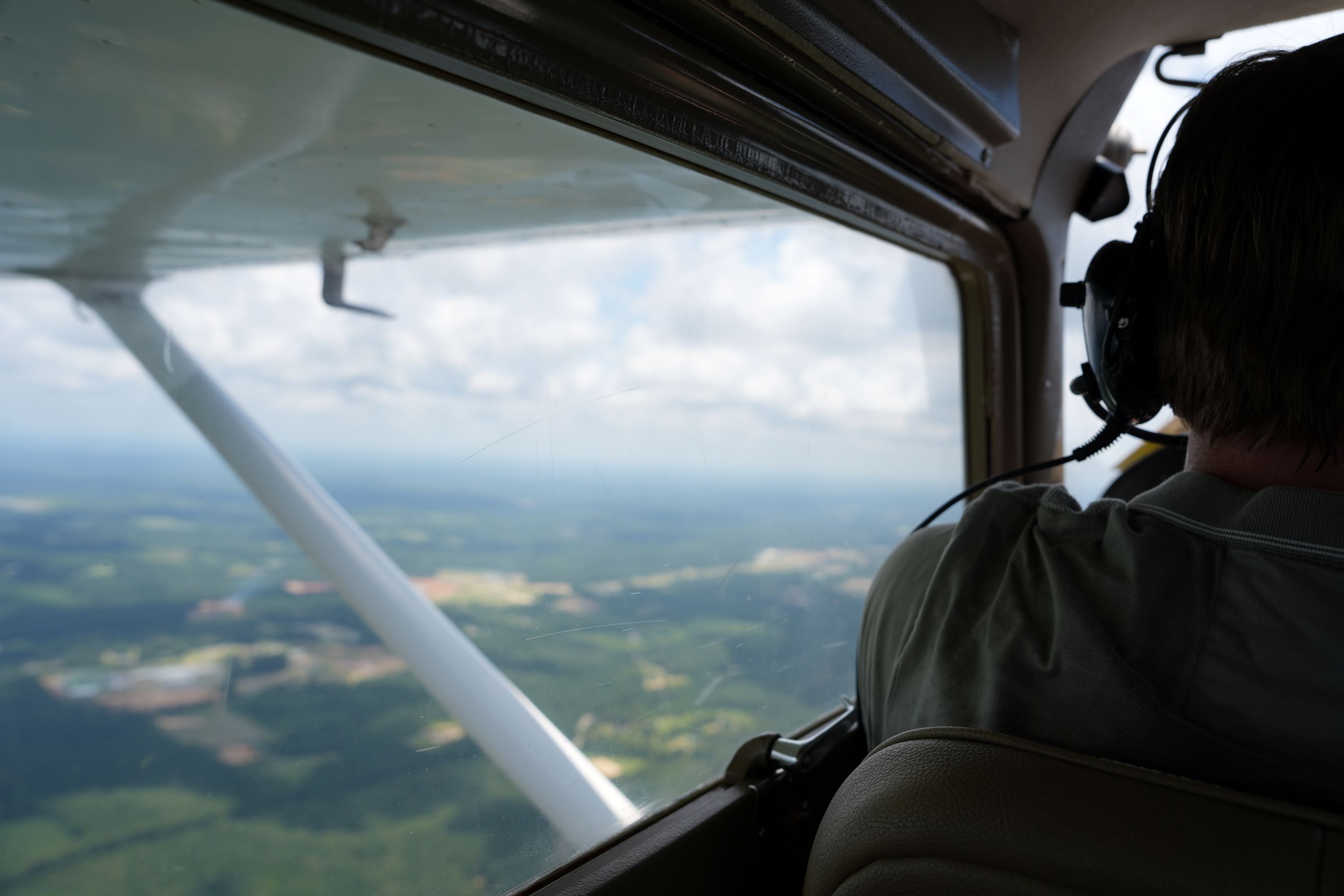
For the current private-pilot airplane practical test, a steep turn is a coordinated 360-degree turn at approximately 45 degrees of bank, performed in both directions. The applicant must maintain entry altitude within 100 feet, airspeed within 10 knots, bank within 5 degrees, and roll out on the entry heading within 10 degrees.
Standards note: These are FAA-S-ACS-6C practical-test tolerances. Use the manufacturer's recommended entry speed or, if one is not published, a speed that does not exceed maneuvering speed. Follow the POH/AFM and instructor guidance for the airplane.
What the maneuver is designed to demonstrate
The FAA Airplane Flying Handbook describes steep turns as a performance maneuver that develops smoothness, coordination, awareness of orientation, division of attention, outside-reference use, and traffic scanning while pitch, bank, power, and load factor change.
In a level turn, lift must increase as bank increases because only the vertical component of lift supports the airplane's weight. The handbook gives a load factor of about 1.41 G at 45 degrees of bank and 2.0 G at 60 degrees in a level turn. Because stall speed increases with the square root of load factor, a level 45-degree turn has a higher stall speed than 1 G flight. That is one reason speed, coordination, and smooth control matter.
Why this skill matters outside the maneuver
Steep turns are not taught because routine flight should use a 45-degree bank. They develop smooth, coordinated control, orientation, division of attention, traffic scanning, and load-factor awareness while pitch, bank, power, and airspeed change together. Those transferable skills matter whenever a pilot must reorient or maneuver while preserving altitude, energy, and outside awareness.
The operational lesson is control and awareness, not an invitation to make unnecessary steep turns at low altitude. A pilot should use the bank angle and maneuver appropriate to the situation, aircraft, altitude, and risk.
Current FAA Private-Pilot Steep-Turn Standards
Area Clearing
Clear the area before beginning the maneuver.
Entry Speed
Use the manufacturer’s recommended airspeed. If none is published, use a speed that does not exceed VA.
Turn
Roll into a coordinated 360-degree turn at approximately 45 degrees of bank.
Direction
Perform the maneuver in the opposite direction as specified by the evaluator.
Altitude
Maintain the entry altitude within ±100 feet.
Airspeed
Maintain airspeed within ±10 knots.
Bank
Maintain bank angle within ±5 degrees.
Rollout
Roll out on the entry heading within ±10 degrees.
Risk Management
Manage traffic, orientation, division of attention, low-altitude risk, distraction, and uncoordinated flight.
Key deviations to check
The FAA handbook's steep-turn error list can be grouped into several useful debrief themes.
1. Altitude changed because pitch and bank were not coordinated
As bank increases, the vertical component of lift decreases unless total lift increases. If the pilot uses only elevator after the nose drops, the bank can steepen and load can rise. The handbook recommends reducing excessive bank with coordinated controls before trying to recover altitude aggressively.
2. Bank angle wandered
An airplane may exhibit an overbanking tendency in a steep turn. Holding a constant bank often requires deliberate control pressure rather than simply placing the wings at 45 degrees and releasing pressure.
3. Airspeed changed because power was not matched to drag
A steep turn increases load factor and induced drag. Power and pitch need to be coordinated to maintain the selected energy state.
4. Rollout began too early or too late
The handbook offers a general lead of roughly half the bank angle, while the exact lead depends on airplane response and rate of roll. The ACS result is what matters: rollout on the entry heading within 10 degrees.
5. Attention became trapped inside the cockpit
The task is visual. Instrument fixation can degrade traffic scanning and outside orientation. The FAA identifies division of attention and collision hazards as explicit risk-management elements.
6. The maneuver was not coordinated
Heading, bank, and altitude may look acceptable while rudder coordination is poor. Portable telemetry that lacks yaw or slip/skid data cannot prove coordination.
What a data-backed review can show
When the relevant fields are available, review:
- altitude trace throughout the 360-degree turn;
- bank-angle stability and peak bank;
- entry and exit heading;
- groundspeed and FlytWERX eIAS trends, clearly labeled and reviewed with the active wind correction;
- pitch and vertical-speed response as bank is established;
- symmetry between left and right turns;
- time spent outside the selected tolerance band.
- the relationship between eIAS, bank, pitch, vertical speed, and altitude throughout the maneuver.
A useful graph marks entry, bank established, largest deviation, rollout started, and wings level. That sequence shows whether the problem began during entry, while holding the turn, or during rollout.
What the data cannot prove by itself
Unless specifically recorded, the data may not establish:
- visual scanning and traffic clearance;
- rudder coordination or slip/skid;
- control pressure, trim use, or power setting;
- whether an avoidance maneuver caused the deviation;
- sensor calibration or mounting quality.
Do not relabel groundspeed as indicated airspeed. FlytWERX eIAS is a separate estimate calculated from GPS-derived speed and atmospheric inputs. When it is used in maneuver grading or debriefing, confirm that the wind correction was current and keep the value clearly labeled as eIAS.
Debrief the turn in phases
Entry
- Was the area clear?
- Was the entry speed appropriate?
- Did bank, pitch, and power changes begin smoothly?
- When did the altitude first begin to deviate?
Established turn
- Was bank stable near 45 degrees?
- Did altitude and speed remain within the private-pilot tolerance?
- Was outside orientation maintained?
- Was the turn coordinated according to instructor observation or appropriate onboard indications?
Rollout
- When did rollout begin?
- Did the pilot reduce the added pitch/power inputs as bank decreased?
- Did the airplane finish on the entry heading, altitude, and speed?
Next attempt
Choose one correction linked to the phase where the error began. Examples include setting a more consistent outside pitch reference, adding power as bank becomes established, or beginning rollout at a repeatable lead point.
How FlytWERX can support the review
FlytWERX provides maneuver-by-maneuver review using available altitude, heading, groundspeed, vertical speed, pitch, bank, course, position, and flight-path data. For supported live-flight sessions, it also calculates eIAS from GPS-derived speed, current winds aloft, temperature, and the active wind correction. Those fields are well suited to showing the shape and timing of a steep turn, but they do not replace the CFI's evaluation of coordination, traffic scan, and control technique.
Frequently asked questions
What bank angle is required for a private-pilot steep turn?
The current ACS calls for approximately 45 degrees of bank, maintained within 5 degrees.
What are the private-pilot tolerances?
Altitude +/-100 feet, airspeed +/-10 knots, bank +/-5 degrees, and rollout heading +/-10 degrees.
Why does stall speed increase in a steep level turn?
The airplane must produce more total lift to maintain altitude, increasing load factor. Stall speed rises with the square root of load factor.
Is 60 degrees of bank required for the private-pilot task?
No. The private-pilot ACS specifies approximately 45 degrees. The FAA handbook discusses 45- to 60-degree steep turns more generally.
Can flight data show whether the turn was coordinated?
Only if the recording includes a reliable coordination or yaw-related source. Bank, heading, and path alone do not prove coordinated flight.
Editorial and safety boundary
This article is educational. It does not replace instruction from a qualified flight instructor, the current Pilot's Operating Handbook or Airplane Flight Manual, approved school procedures, or the pilot in command's responsibility for safe operation. FAA practical-test tolerances are evaluation standards for the applicable certificate or rating; they are not a substitute for aircraft-specific procedures or sound judgment.
• FAA Airman Certification Standards page - Federal Aviation Administration
• Private Pilot for Airplane Category Airman Certification Standards, FAA-S-ACS-6C - Federal Aviation Administration
• Airplane Flying Handbook Chapter 10: Performance Maneuvers - Federal Aviation Administration
• Airplane Flying Handbook Chapter 4: Energy Management - Federal Aviation Administration
• FlytWERX App Store listing - Apple / Vista Techwerx LLC
• FlytWERX eIAS methodology and instructor field observation - first-party product information supplied by FlytWERX, July 2026