
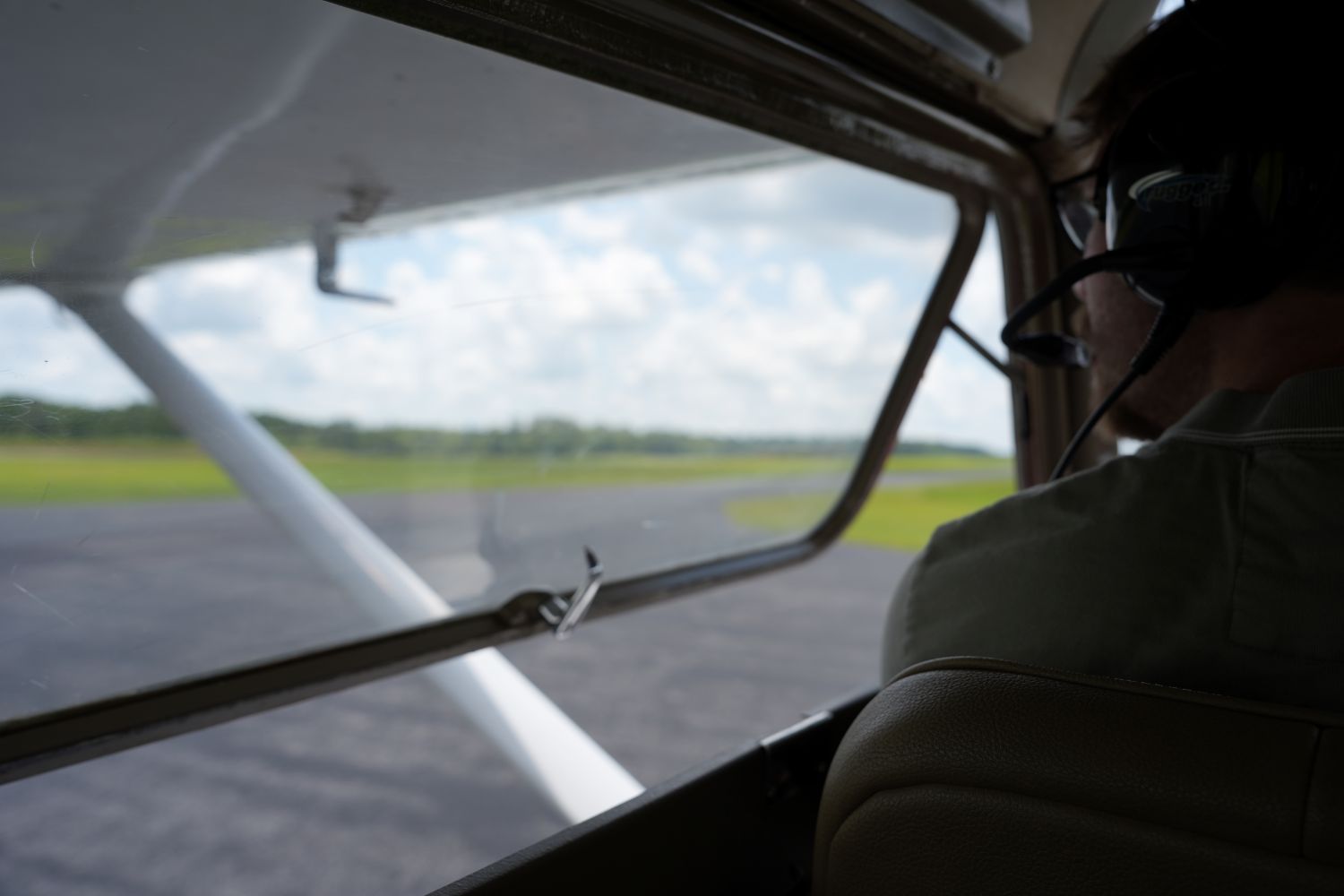
A normal approach and landing is the baseline arrival maneuver for a suitable runway and ordinary operating conditions. It demonstrates that the pilot can select and verify the correct landing surface, manage energy, compensate for wind, maintain a stabilized approach, touch down under control, and go around early when traffic, runway conditions, or the airplane's flight path make continued landing unsafe.
Standards note: The current private-pilot standard is FAA-S-ACS-6C, Area of Operation IV, Task B. The POH/AFM supplies the aircraft-specific approach speed, configuration, limitations, and landing procedure. The ACS is an evaluation standard, not an operating checklist.
Why pilots really learn this maneuver
Normal landing training is not just about making a smooth touchdown. It develops the chain of decisions that must work every time an airplane returns to the ground:
- identify the correct runway or landing surface;
- scan the runway and adjoining area for traffic and obstructions;
- choose an appropriate touchdown point;
- control airspeed, descent, alignment, and wind drift;
- recognize when an approach is no longer stable or conflict-free;
- transition immediately to a go-around rather than trying to salvage the landing.
A landing can feel soft and still be poor if it occurs long, with side drift, on the wrong surface, or after an unstable approach. Conversely, a touchdown that is not perfectly smooth may still reflect a sound decision and controlled arrival. The complete maneuver matters more than the last second.
A realistic scenario: traffic has not cleared the runway
The pilot is established on final, but another airplane is still on the runway and may not clear in time. The FAA Airplane Flying Handbook says that an early go-around may be appropriate when a conflict appears likely. Continuing lower while hoping the runway will clear reduces time and options.
After a go-around, the aircraft initially transitions from final approach into a climb. The FAA's traffic-pattern guidance describes the upwind leg after a go-around and notes that, once a safe altitude has been reached, a shallow turn toward the upwind side of the airport can improve visibility of the runway for departing traffic. That is the realistic reason instructors may teach an upwind displacement or "side-step" in the appropriate traffic pattern: it helps the pilot see and avoid traffic that may be departing or still occupying the runway.
This is not a universal command to turn immediately after every go-around. The pilot must first maintain aircraft control and a safe climb, comply with ATC instructions at a towered airport, follow the established traffic pattern and local procedures, account for parallel runways and obstacles, and avoid turning into other traffic. The exact path is situational.
The ACS go-around task reinforces the same operational purpose: when necessary, the applicant must maneuver to the side of the runway or landing area to clear and avoid conflicting traffic. That is a conflict-avoidance action, not a routine turn made without checking traffic, ATC instructions, parallel-runway flows, terrain, and obstacles.
Current FAA Private-Pilot Standards
Under FAA-S-ACS-6C, Area of Operation IV, Task B, the applicant must demonstrate the knowledge, risk management, and flight skills required for a normal approach and landing.
Landing surface and traffic scan
The pilot must align the airplane with the correct or assigned runway or landing surface and scan the runway and adjoining area for traffic and obstructions.
Touchdown planning
The pilot must select and aim for a suitable touchdown point based on the wind, runway surface, available distance, and nearby obstructions.
Stabilized approach
The manufacturer-recommended configuration, airspeed, and trim must be established. Pitch and power should be adjusted as needed to maintain a stabilized approach.
Approach speed
The pilot must maintain the manufacturer’s published approach speed within +10/-5 knots.
If no approach speed is published, the ACS specifies no more than 1.3 VSO within +10/-5 knots, with the appropriate gust factor applied.
Wind correction and directional control
Directional control and the appropriate crosswind correction must be maintained throughout the approach and landing.
Touchdown
The airplane must touch down in the proper pitch attitude on the specified point or within 400 feet beyond it.
At touchdown, there should be no side drift, and the airplane’s longitudinal axis should be aligned with and over the runway centerline or intended landing path.
Go-around
A timely go-around must be initiated whenever the approach cannot be maintained within tolerance or another condition makes the approach or landing unsafe.
Risk management
The pilot must consider:
- Runway selection
- Wind and crosswind conditions
- Windshear
- Tailwinds
- Wake turbulence
- Runway-surface conditions
- Traffic and obstacles
- Low-altitude loss of control
- Distraction
- Runway incursions
The touchdown tolerance is not permission to force the airplane onto the runway. It is one part of a controlled, stabilized sequence.
What "stabilized" means in practical terms
The FAA ACS requires a stabilized approach but does not publish one universal set of gates for every light airplane. Schools and operators may define specific stabilized-approach criteria. In general, the pilot should be able to recognize whether the airplane is:
- on the intended flight path;
- at an appropriate airspeed and configuration;
- descending at a manageable rate;
- aligned or correcting predictably for the runway;
- requiring only normal control changes;
- positioned to touch down in the intended area;
- free of a developing traffic or obstacle conflict.
If large corrections, excessive speed, steep bank, high sink, poor alignment, or uncertainty persist close to the surface, the safer response is usually to go around rather than force the landing. The CFI, school procedures, POH/AFM, and actual conditions determine the operational decision.
Key deviations to examine
1. The wrong landing surface was never positively ruled out
A pilot can become visually committed to a taxiway, parallel runway, road, displaced threshold, or closed portion of a surface. The approach review should begin with runway verification, not touchdown smoothness.
2. The runway scan stopped after turning final
Traffic may enter, fail to clear, or begin a takeoff after the pilot is established on final. The pilot must continue scanning and listening rather than treating a landing clearance or earlier visual check as a guarantee.
3. Airspeed was corrected late instead of energy being managed early
Airspeed, altitude, distance, configuration, power, and wind are connected. Chasing the speed indicator close to the runway may mask a larger energy problem that began on downwind or base.
4. Wind correction was removed too soon
The airplane should not drift sideways at touchdown. Crosswind control generally changes through the flare and rollout as airspeed decreases. A debrief should examine heading, ground track, bank, and alignment together rather than using one number as the whole story.
5. The pilot focused on a smooth touchdown and landed long
Holding the airplane off indefinitely can consume runway. A normal landing is not a contest for the softest possible arrival. The goal is a controlled touchdown in the planned area with proper alignment and continued control.
6. The go-around decision came after options had narrowed
An early go-around is a normal maneuver, not a failure. Delaying it can create a low-energy, high-workload transition near the ground. The debrief should ask when the first unsafe or unstable condition became clear and how soon the decision followed.
How FlytWERX can support the review
FlytWERX supports normal approach and landing as a structured maneuver. With a compatible data source, available telemetry can help the student and instructor review:
- ground track from traffic pattern or final approach through rollout;
- runway alignment and lateral drift;
- altitude and vertical-speed trends;
- pitch and bank changes;
- heading, course, and wind correction;
- GPS speed and FlytWERX estimated indicated airspeed;
- the recorded flight path, which can help the instructor approximate threshold crossing, flare, and touchdown location during debrief;
- repeated landing attempts and performance history.
The most useful question is often not "Was the touchdown good?" It is "Where did the first meaningful deviation begin?" A long landing may begin with a tailwind on base, excess altitude turning final, late configuration, or speed that was never stabilized.
FlytWERX estimated indicated airspeed
For supported live-flight reviews, FlytWERX produces estimated indicated airspeed, or eIAS, from GPS speed, current winds aloft, and temperature. A pilot or instructor can update the wind correction using more representative winds for the actual training area.
When the wind correction is current, FlytWERX instructors have observed eIAS averaging approximately 1 to 3 knots from the airplane's indicated airspeed. This is a first-party operational observation, not an independently certified accuracy guarantee. Wind near the runway can differ from winds aloft, gusts can change quickly, and maneuvering or sensor limitations can increase the difference. The airplane's approved airspeed indication remains controlling during the approach.
For a landing debrief, record the wind source and time. If the pilot updates the wind in the training area or near the airport, note that update so the instructor can understand how the eIAS estimate was produced.
Debrief the landing by phase
Pattern and setup
- Was the correct runway identified?
- Were wind, traffic, surface condition, and available distance considered?
- Was configuration planned early enough to avoid rushing?
Final approach
- Was the flight path stable?
- Was the airplane at the aircraft-specific target speed?
- Did eIAS and panel IAS tell a consistent story, allowing for estimation uncertainty?
- Was traffic still being scanned?
Roundout and touchdown
- Did lateral drift develop?
- Was the longitudinal axis aligned with the runway?
- Did pitch and vertical speed change smoothly?
- Was touchdown in the intended area?
Rollout
- Was directional control maintained?
- Did wind-control inputs remain appropriate as the airplane slowed?
- Was the runway exited only when safe and under control?
Go-around, if flown
- What condition triggered the decision?
- How quickly were power, pitch, configuration, and climb stabilized according to the POH/AFM?
- Was the runway and other traffic kept in sight as practical?
- After reaching a safe altitude, was the upwind path appropriate for ATC instructions, traffic, obstacles, parallel runways, and the airport's pattern?
What the data cannot establish by itself
A recording may not reveal:
- everything the pilot could see from the cockpit;
- whether a landing clearance was received or amended;
- the precise location and intent of other traffic;
- exact control inputs, braking, tire loading, or surface feel;
- runway contamination or braking action;
- whether a go-around path complied with a specific ATC instruction;
- whether the pilot made the correct aircraft-specific checklist callouts;
- a certified touchdown distance or threshold-crossing height.
The instructor should combine the data with direct observation, radio context, pilot recollection, airport information, weather, and the POH/AFM.
A practical FlytWERX landing debrief
1. State the purpose. Normal landing, crosswind emphasis, stabilized-approach practice, or go-around decision training?
2. Rebuild the conditions. Runway, wind, traffic, surface, and aircraft configuration.
3. Find the first divergence. Path, altitude, speed, bank, heading, or decision timing.
4. Verify eIAS inputs. Wind source, time, temperature, and any in-flight update.
5. Separate the result from the cause. A long touchdown is the result; the instructor identifies whether the cause was excess speed, altitude, delayed flare, wind, or another factor.
6. Choose a specific correction. For example, an earlier configuration point, a clearer stabilized gate, or a prompt go-around trigger.
7. Compare the next attempt. Review whether the approach became stable earlier and required fewer late corrections.
Frequently asked questions
What is the private-pilot touchdown tolerance for a normal landing?
The ACS requires touchdown on the specified point or within 400 feet beyond it, in the proper pitch attitude, with no side drift and the airplane aligned with the runway centerline or landing path.
What approach speed does the ACS require?
Use the manufacturer's published approach speed. If one is not published, the ACS standard is no more than 1.3 VSO, within +10/-5 knots, with gust factor applied. The POH/AFM and instructor determine the operational target.
Why might a pilot move to the upwind side after a go-around?
The FAA traffic-pattern handbook explains that, after reaching a safe altitude, a shallow turn to the upwind side can improve runway visibility for departing aircraft. It is situational and must be consistent with ATC instructions, local procedures, traffic, obstacles, and parallel-runway considerations.
Is every unstable approach an automatic go-around?
The ACS requires a timely go-around when the approach cannot be completed within tolerance or another condition makes it unsafe. Schools and instructors may define more specific stabilized-approach gates. The pilot should not continue solely to avoid "wasting" an approach.
Can FlytWERX prove that a landing met the ACS?
FlytWERX can support a debrief with available flight data and maneuver feedback. A CFI or examiner evaluates the complete performance, including visual scan, judgment, control use, risk management, and aircraft-specific procedure.
Can eIAS be used during the landing review?
Yes, as an estimated debrief value when the wind correction and temperature inputs are current. It does not replace the panel IAS, and small differences should be interpreted with the estimate's uncertainty in mind.
Editorial and safety boundary
This article is educational and requires review by a named CFI. It does not prescribe a universal stabilized-approach gate, go-around path, or wind technique. The POH/AFM, ATC instructions, airport procedures, actual traffic and weather, school or operator policy, and pilot-in-command judgment govern the flight. FlytWERX is a training and debrief platform, not a primary flight instrument or collision-avoidance system.
- FAA, Airman Certification Standards: https://www.faa.gov/training_testing/testing/acs
- FAA, Private Pilot for Airplane Category Airman Certification Standards, FAA-S-ACS-6C, Area of Operation IV, Tasks B and N: https://www.faa.gov/training_testing/testing/acs/private_airplane_acs_6.pdf
- FAA, Airplane Flying Handbook, Chapter 8, Airport Traffic Patterns: https://www.faa.gov/sites/faa.gov/files/regulations_policies/handbooks_manuals/aviation/airplane_handbook/09_afh_ch8.pdf
- FAA, Airplane Flying Handbook, Chapter 9, Approaches and Landings: https://www.faa.gov/sites/faa.gov/files/regulations_policies/handbooks_manuals/aviation/airplane_handbook/10_afh_ch9.pdf
- FAA, Aeronautical Information Manual: https://www.faa.gov/air_traffic/publications/atpubs/aim_html/
- FAA, Aviation Weather Handbook, FAA-H-8083-28B: https://www.faa.gov/regulationspolicies/handbooksmanuals/aviation/faa-h-8083-28b-aviation-weather-handbook
- FlytWERX product page: https://www.flytwerx.com/
- FlytWERX App Store listing: https://apps.apple.com/us/app/flytwerx/id6758866523
- FlytWERX eIAS methodology and 1-to-3-knot field observation: product-owner statement supplied July 2026; publish a public methodology note before external release.