
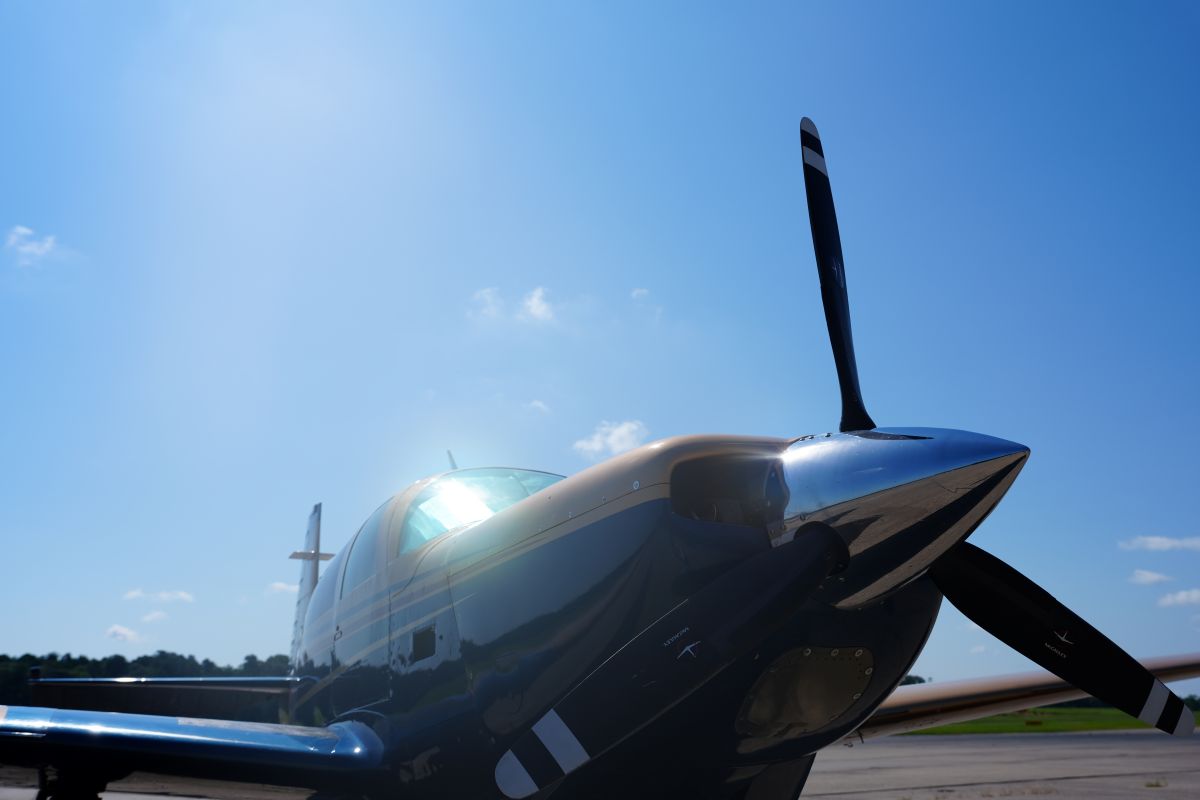
A soft-field landing is designed to touch down with minimum vertical speed, keep the airplane moving, and reduce loading on the landing gear when the surface may be soft or rough.
The pilot maintains a stabilized approach, lands with no side drift, keeps the nosewheel off as long as aerodynamic control remains effective, and uses the manufacturer-recommended controls while exiting the soft area.
The technique is specific to the aircraft and surface.
Standards note: The current private-pilot standard is FAA-S-ACS-6C, Area of Operation IV, Task D. The POH/AFM supplies the actual configuration, approach speed, power technique, pitch attitude, and after-landing procedure. A soft-field technique does not make a muddy, flooded, snow-covered, obstructed, or otherwise unsuitable landing area acceptable.
Why Pilots Really Learn This Maneuver
A paved runway usually supports the tires immediately. A soft or rough surface may not.
Grass, sand, mud, snow, ruts, standing water, or uneven terrain can increase drag, reduce steering effectiveness, and place high loads on the landing gear.
The real-world purposes are to:
- Minimize sink and impact at touchdown
- Touch down without lateral drift that can load the landing gear
- Keep weight off the nosewheel as long as practical
- Avoid stopping where the tires may sink or bog down
- Maintain control while taxiing clear at a safe speed
- Recognize when the field condition makes landing unacceptable
A Realistic Scenario
A pilot plans to land on a maintained turf runway. The field report is favorable, but the pilot still evaluates recent rain, drainage, wind, length, obstacles, runway slope, braking expectations, and whether the airplane can taxi without becoming stuck.
On final, the objective is not to “grease it on” at any cost.
The pilot flies a stable, aircraft-specific speed, controls the descent with power and pitch, touches down with minimum sink and no drift, protects the nosewheel, and keeps moving until reaching firmer ground.
If the field condition is uncertain or the approach becomes unstable, the correct action may be to go around and use another runway or airport.
Current FAA Private-Pilot Standards
Under FAA-S-ACS-6C, Area of Operation IV, Task D, the applicant must demonstrate the planning, risk management, and flight skills required for a soft-field approach and landing.
Planning
The pilot must select a suitable runway or landing area based on:
- Pilot capability
- Aircraft performance and limitations
- Available landing distance
- Wind
- Surface condition
Approach Setup
The pilot must:
- Complete the appropriate checklist
- Make any required radio calls
- Align with the correct runway or landing surface
- Scan for traffic and obstructions
- Select a suitable touchdown area
Stabilized Approach
The manufacturer-recommended configuration, airspeed, and trim must be established.
Pitch and power should be adjusted as necessary to maintain a stabilized approach.
Approach Speed
The pilot must maintain the manufacturer’s published approach speed within +10/-5 knots.
If the manufacturer does not publish an approach speed, the ACS specifies no more than 1.3 VSO within +10/-5 knots, with the appropriate gust factor applied.
Wind Correction and Directional Control
Directional control and the appropriate crosswind correction must be maintained throughout the approach, touchdown, and landing rollout.
Touchdown
The airplane must touch down:
- In the proper pitch attitude
- With minimum sink rate
- With no side drift
- Aligned with the runway centerline or intended landing path
Nosewheel Management
The pilot must keep the nosewheel off the surface until elevator effectiveness is lost.
The exact technique must follow the POH/AFM and instructor guidance.
After Landing
The pilot must use elevator and other flight-control inputs as recommended by the manufacturer.
The airplane should exit the soft area at a speed that prevents it from sinking or becoming stuck while still maintaining safe taxi control.
Go-Around
A timely go-around must be initiated whenever the approach or landing cannot be completed safely.
Unlike the normal and short-field landing tasks, the soft-field task is centered on surface protection and a controlled, minimum-sink touchdown rather than a published 200- or 400-foot touchdown tolerance.
Key Deviations to Examine
1. The Field Was Treated as Suitable Without Enough Information
The runway may be long enough on paper but still be unsafe because of soft spots, standing water, tall grass, ruts, snow, or inadequate taxi access.
The debrief should begin with the decision to use the landing area.
2. The Approach Carried Unnecessary Speed
Excess speed can produce float, reduce touchdown control, and extend the time the airplane is exposed to changing wind close to the surface.
It can also lead to a later touchdown on a field where stopping and taxiing margins matter.
3. The Descent Rate Was Arrested Too Abruptly
A large, late flare can produce a balloon, loss of alignment, or a firm settle.
The objective is a controlled, minimum-sink touchdown using the aircraft-specific relationship among pitch, power, speed, and height.
4. Side Drift Remained at Touchdown
A soft surface does not eliminate crosswind requirements.
Touching down while moving sideways can load the landing gear and reduce directional control.
5. The Nosewheel Was Lowered Too Early or Forced Down
The ACS expects the nosewheel to remain off until elevator effectiveness decreases.
Forcing it down can increase loading and the risk of the nosewheel digging into the surface.
6. The Airplane Stopped Unnecessarily on the Soft Area
Once safely on the ground, the pilot may need enough momentum to reach a firmer surface.
Taxi speed must still remain safe and controllable. The objective is not to rush across the field.
How FlytWERX Supports the Review
A supported FlytWERX recording can help the student and instructor examine:
- eIAS and GPS-speed trends on final
- Altitude and vertical-speed trends
- Pitch and bank
- Heading, course, ground track, and wind correction
- The 3D flight path and approach stability
- Alignment and rollout-accuracy information when available
- Instructor grading, notes, targets, and attempt history
The review should also include the runway-surface report, actual field observations, wind, temperature, airplane configuration, and the instructor’s description of the touchdown and nosewheel technique.
FlytWERX does not directly measure tire sink, nosewheel loading, surface firmness, or braking effectiveness.
FlytWERX Estimated Indicated Airspeed
For supported live-flight reviews, FlytWERX combines GPS speed, current winds aloft, and temperature to produce estimated indicated airspeed, or eIAS.
A pilot or instructor can update the wind correction when more representative wind information is available for the training area.
Current instructor field observations generally show eIAS about 1 to 3 knots from the airplane’s indicated airspeed when the wind correction is current.
This is an internal operational observation, not an independently certified accuracy guarantee. Wind near the runway can differ from winds aloft, and gusts, rapid changes, stale inputs, and sensor limitations can increase the difference.
The airplane’s approved IAS remains controlling in flight.
Because a soft-field touchdown depends on appropriate energy and sink rate, the combined eIAS, vertical-speed, pitch, and flight-path trends can make the debrief more specific than a memory-only discussion.
A Segment-by-Segment FlytWERX Debrief
Segment 1: Field and Approach Decision
- Was the field actually suitable?
- Was there enough information about its condition?
- Were length, wind, obstacles, and the taxi route considered?
Segment 2: Stabilized Final
- Did eIAS, vertical speed, alignment, and bank settle into a manageable pattern?
- Were the required corrections increasing or decreasing?
Segment 3: Flare and Touchdown
- Did pitch and vertical speed show a controlled transition?
- Was there lateral drift?
- Was there an abrupt correction close to the surface?
Segment 4: Nosewheel Management
Telemetry may show pitch decay and groundspeed, but the instructor must describe when and how the nosewheel touched down.
The debrief should ask whether the pilot preserved elevator effectiveness without over-rotating.
Segment 5: Rollout and Exit
- Did the airplane remain aligned and moving under control?
- Was it taxied clear without stopping in a soft area?
- Was a safe and controllable taxi speed maintained?
What the Data Cannot Establish by Itself
FlytWERX cannot independently determine:
- Runway firmness
- Rut depth
- Standing water
- Grass height
- Snow condition
- Wheel loading
- Tire sink
- Nosewheel impact
- Landing-gear stress
- Actual braking effectiveness
- Steering response
- Exact touchdown feel
- Minimum sink at the wheels
- The pilot’s outside scan
- The quality of the field-condition decision
- Whether the runway should have been used
- Exact IAS compliance from eIAS alone
Those conclusions require field information, aircraft data, direct observation, and pilot-in-command judgment.
Editorial and Safety Boundary
This article does not approve any unimproved or contaminated runway.
A named CFI and the FlytWERX product owner must review it before publication.
The POH/AFM, airport and field information, weather, school procedures, ATC instructions, and pilot-in-command judgment control the operation.
Any published example must use verified, de-identified data and clearly state the surface and wind inputs.
Frequently Asked Questions
Is a soft-field landing only for grass?
No. A soft-field technique may be relevant to grass, mud, sand, snow, rough surfaces, or other conditions that create wheel-loading and rolling-resistance concerns.
The field must still be suitable for the airplane and actual conditions.
Why keep the nosewheel off the surface?
Keeping weight off the nosewheel reduces the chance that it will dig into a soft surface and helps protect the landing gear.
The ACS says to keep the nosewheel off until elevator effectiveness is lost. The exact technique follows the POH/AFM.
Should a soft-field landing always use power into touchdown?
Many training techniques use power to control sink rate and produce a smooth touchdown.
The exact power, pitch, and configuration procedure is aircraft-specific and must follow the POH/AFM and instructor guidance.
Is there a 200-foot soft-field touchdown standard?
No. The current private-pilot soft-field task does not use the short-field landing task’s 200-foot accuracy tolerance.
It evaluates a controlled, aligned, minimum-sink touchdown and proper after-landing technique.
Can FlytWERX tell whether the runway was too soft?
No. FlytWERX can help review the airplane’s motion and performance, but field suitability requires actual surface information and pilot judgment.
How should two attempts be compared?
Document the surface, wind correction, configuration, target speed, temperature, and aircraft loading.
Compare the stability and timing of corrections rather than assuming that a lower score or shorter track automatically proves a better landing.
- FAA, Airman Certification Standards
https://www.faa.gov/training_testing/testing/acs - FAA, Private Pilot for Airplane Category ACS, FAA-S-ACS-6C, Area of Operation IV, Task D
https://www.faa.gov/training_testing/testing/acs/private_airplane_acs_6.pdf - FAA, Airplane Flying Handbook, Chapter 9: Approaches and Landings
https://www.faa.gov/sites/faa.gov/files/regulations_policies/handbooks_manuals/aviation/airplane_handbook/10_afh_ch9.pdf - FAA, Pilot’s Handbook of Aeronautical Knowledge, Chapter 11: Aircraft Performance
https://www.faa.gov/regulationspolicies/handbooksmanuals/aviation/phak/chapter-11-aircraft-performance - FlytWERX product page
https://www.flytwerx.com/ - FlytWERX App Store listing
https://apps.apple.com/us/app/flytwerx/id6758866523 - FlytWERX eIAS methodology and 1-to-3-knot instructor field observation
Product-owner statement supplied July 2026. Publish a public methodology note before external release.