
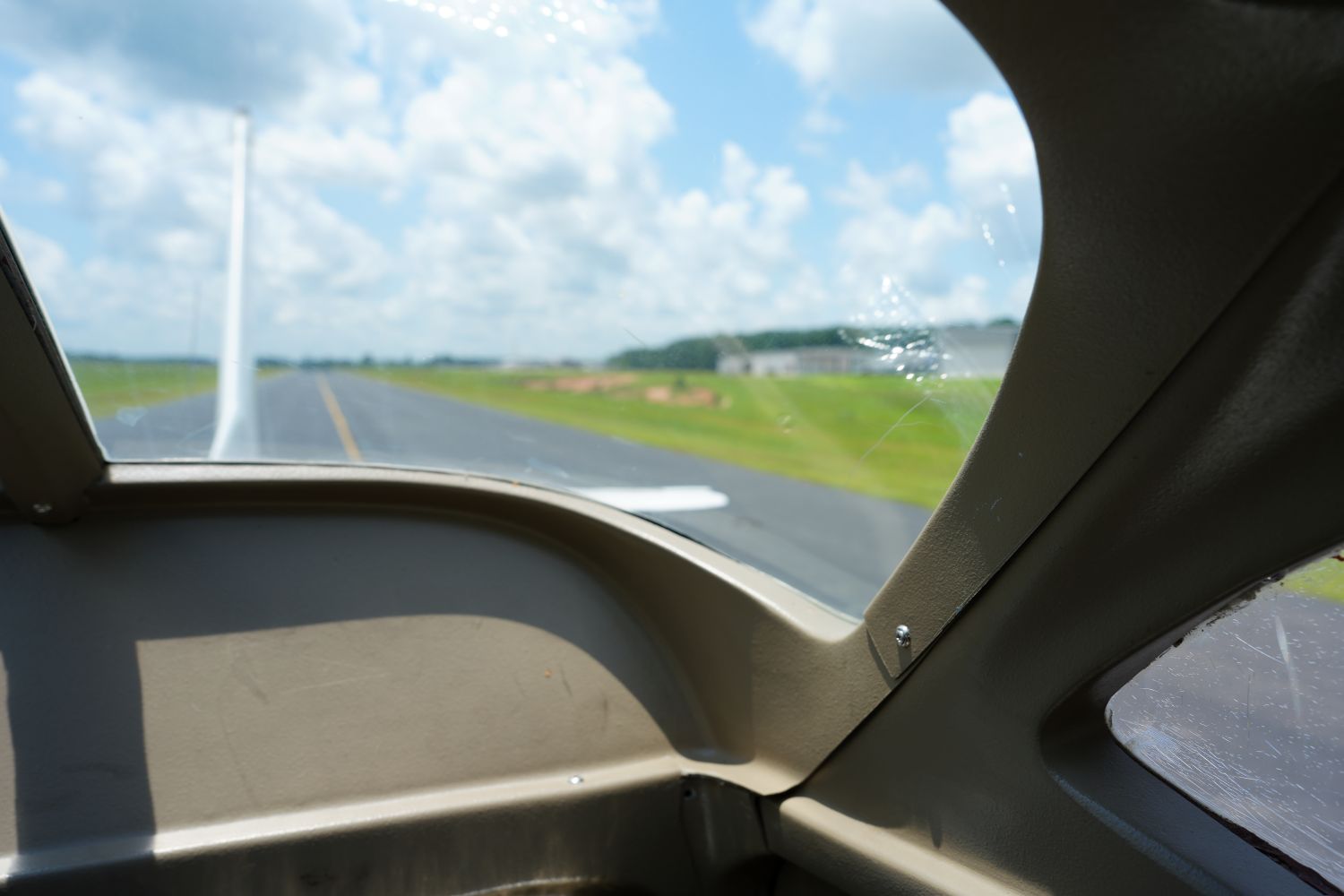
A soft-field takeoff teaches a pilot to reduce wheel drag and landing-gear loading when departing from a soft or rough surface. The airplane is kept moving, weight is transferred from the wheels to the wings, lift-off occurs at the lowest practical airspeed, and the airplane remains in ground effect while accelerating to the aircraft-specific climb speed. It is not simply a normal takeoff with extra back pressure.
Standards note: The current private-pilot standard is FAA-S-ACS-6C, Area of Operation IV, Task C. The airplane's POH/AFM controls the configuration, pitch attitudes, lift-off technique, climb speed, flap use, and limitations for the actual aircraft and surface.
Why pilots really learn this maneuver
The FAA Airplane Flying Handbook discusses soft- and rough-field departures in the context of surfaces such as tall grass, soft sand, mud, and snow. These surfaces can create more rolling resistance, increase the chance of a wheel sinking or bogging down, and place additional loads on the landing gear. The practical objective is to get weight off the wheels without trying to climb before the airplane has enough airspeed.
Real-world uses include:
- departing a suitable turf runway after the pilot has assessed its condition;
- operating from a rough strip where minimizing impact and wheel loading matters;
- avoiding an unnecessary stop that could let the tires settle into a soft surface;
- using ground effect to accelerate after an early lift-off instead of forcing an unsafe climb;
- maintaining directional control when the surface does not provide the same response as smooth pavement.
The maneuver also develops a more general skill: understanding that "airborne" and "ready to climb" are not always the same condition. An airplane can lift off at a low speed in ground effect and still lack the performance to climb safely out of ground effect. The pilot must manage pitch and acceleration without settling back onto the runway or attempting to climb too early.
A realistic scenario
A pilot plans to depart a turf runway after overnight rain. Before taxiing onto it, the pilot must determine that the surface is actually suitable, review performance and limitations, and consider whether the airplane can be turned around or stopped if acceleration is poor. During the takeoff, stopping on the soft area could allow the wheels to sink and increase the power needed to get moving again. The pilot keeps the airplane moving, uses the manufacturer-recommended control position, transfers weight to the wings, lifts off in ground effect, and accelerates to the proper climb speed before climbing away.
The technique does not make an unsuitable runway suitable. If the surface condition, available distance, wind, airplane performance, or pilot capability is inadequate, the correct decision is not to attempt the takeoff.
Current FAA Private-Pilot Standards
Under FAA-S-ACS-6C, Area of Operation IV, Task C, the applicant must demonstrate the knowledge, risk management, and flight skills required for a soft-field takeoff, climb, and rejected-takeoff procedure.
Before entering the runway, the pilot must verify the correct runway, determine the wind direction, and position the flight controls appropriately for the existing wind.
The pilot should clear the area, maintain the necessary control inputs, align the airplane with the runway centerline without stopping, and smoothly advance the power. Takeoff power and proper engine and flight-instrument indications must be confirmed.
During acceleration, the pilot must establish a pitch attitude that transfers the airplane’s weight from the wheels to the wings as quickly as practical.
Lift-off should occur at the lowest practical airspeed. After becoming airborne, the airplane must remain in ground effect while accelerating to VX or VY, as appropriate for the aircraft and conditions.
The selected climb speed must then be established and maintained within +10/-5 knots.
Configuration changes should follow the manufacturer’s guidance and occur only after a positive rate of climb has been verified, unless the POH/AFM directs otherwise.
Directional control and appropriate wind-drift correction must be maintained throughout the takeoff roll, lift-off, ground-effect acceleration, and climb.
The pilot must also manage risks associated with the runway’s surface condition, available takeoff distance, wind, rejected-takeoff planning, engine failure, collision hazards, low-altitude loss of control, and distraction.
The ACS does not provide one universal pitch attitude, flap setting, or lift-off speed for every airplane. Those procedures and values must come from the aircraft’s current POH/AFM and instructor guidance.
Soft-Field Takeoff Is Not the Same as Short-Field Takeoff
Soft-field and short-field takeoffs are designed to solve different operational problems.
A soft-field takeoff is used to reduce wheel drag and landing-gear loading on a soft or rough surface. The pilot transfers the airplane’s weight from the wheels to the wings, lifts off at the lowest practical airspeed, and remains in ground effect while accelerating to the appropriate climb speed.
A short-field takeoff is used when the available runway is limited or an obstacle must be cleared. The pilot uses the maximum available takeoff area, establishes the manufacturer-recommended obstacle-clearance speed or VX, and transitions to VY after the obstacle is cleared.
The key distinction is what happens immediately after lift-off. During a soft-field takeoff, the airplane remains close to the surface and accelerates in ground effect before beginning the climb. During a short-field takeoff, the pilot establishes the specified obstacle-clearance profile and maintains it until the obstacle is cleared.
A runway can be both short and soft, but the pilot should not improvise a combination of the two procedures. The aircraft’s POH/AFM, performance data, runway condition, actual obstacles, and instructor guidance determine whether the operation is acceptable and how the techniques should be applied.
Key deviations to review
1. Treating the surface as an afterthought
A soft-field takeoff starts with surface assessment. Standing water, deep mud, ruts, snow, tall wet grass, hidden debris, slope, and inadequate drainage may change the decision entirely. A flight track cannot determine the bearing strength or condition of the runway.
2. Stopping unnecessarily on the soft area
The ACS calls for aligning without stopping while smoothly advancing power. Stopping can increase the chance of sinking into the surface. That does not mean rushing onto a runway or skipping required checks. The checklist, radio calls, traffic scan, runway verification, and takeoff decision must be complete before the airplane enters the takeoff path.
3. Failing to transfer weight to the wings
If the pilot holds a flat attitude, the wheels may continue carrying more load and creating more drag. Excessive nose-up input can create the opposite problem: premature lift-off, poor visibility, tail-strike risk in some aircraft, or an abrupt pitch change. The correct sight picture and control pressure are aircraft-specific.
4. Trying to climb immediately after lift-off
The airplane may leave the surface below normal climb speed because ground effect reduces induced drag. The pilot should remain in ground effect and accelerate according to the POH/AFM. Attempting to climb too soon can produce mushy control, settling, or an inability to clear obstacles.
5. Remaining in ground effect too long
Ground effect is a transition, not the destination. Once the selected climb speed is established, the pilot should set the proper climb attitude. Staying low without a reason can reduce obstacle clearance and expose the airplane to runway-end hazards.
6. Letting wind correction disappear after lift-off
Crosswind correction changes as the airplane accelerates and becomes airborne, but the need for directional control does not end. The pilot must keep the airplane aligned with the intended departure path and avoid drift toward obstacles or adjacent surfaces.
How FlytWERX can support the debrief
FlytWERX supports soft-field takeoff as a structured training maneuver. With a compatible live-flight data source, the student and instructor can review available telemetry such as:
- ground track and runway alignment;
- heading, course, and wind-drift trend;
- GPS speed and FlytWERX estimated indicated airspeed;
- pitch and bank trend;
- approximate lift-off point;
- altitude and vertical-speed development;
- the transition from ground effect to the climb;
- repeated attempts and maneuver history.
A useful review can divide the maneuver into five phases: runway entry, acceleration, weight transfer, lift-off and ground-effect acceleration, and climb-speed capture. The data helps identify where the attempt changed. The instructor still determines why it changed and what correction is appropriate.
FlytWERX estimated indicated airspeed
For supported live-flight reviews, FlytWERX provides an estimated indicated airspeed, or eIAS. It does not treat GPS groundspeed as IAS. FlytWERX combines GPS speed with current winds aloft and temperature, and the pilot or instructor can update the wind correction using a more representative wind for the training area.
When the wind correction is current, FlytWERX instructors have observed eIAS averaging approximately 1 to 3 knots from the airplane's indicated airspeed. This is a first-party field observation, not an independently certified accuracy specification or a guarantee for every flight. Rapidly changing or localized wind, stale inputs, maneuvering, sensor limitations, and the airplane's own instrument error can increase the difference. The airplane's approved airspeed indication remains controlling in flight.
During a soft-field debrief, eIAS is useful for reviewing whether acceleration continued after lift-off and when the selected climb-speed region was reached. It should not be used to justify an operational decision when the wind input is uncertain.
What the data cannot establish by itself
FlytWERX cannot determine from telemetry alone:
- whether the runway surface was suitable or strong enough;
- whether the wheels were beginning to sink or drag;
- the exact elevator, rudder, or aileron input;
- landing-gear loads or tire condition;
- whether the pilot had adequate outside visibility;
- whether the airplane was configured exactly as required;
- whether a stop or rejected takeoff could have been completed safely;
- whether the pilot used the correct POH/AFM procedure.
The recording should be combined with the pilot's account, instructor observation, runway and weather information, aircraft performance data, and the current POH/AFM.
A practical FlytWERX debrief
1. Confirm the operational purpose. Was this a simulated soft-field technique on pavement or an actual suitable soft/rough surface?
2. Review the runway decision. Surface condition, wind, distance, performance, obstacles, and reject considerations.
3. Identify the first divergence. Did it begin with runway alignment, weight transfer, lift-off, ground-effect acceleration, or climb-speed capture?
4. Check environmental inputs. Confirm the wind and temperature used for eIAS and note their source and time.
5. Separate observation from diagnosis. "Pitch increased sharply after lift-off" is visible evidence; the instructor determines whether the cause was sight picture, control pressure, trim, or another factor.
6. Assign one correction. Use a specific visual cue or control action from the instructor.
7. Compare the next attempt. Did lift-off, acceleration, and climb transition become smoother and more repeatable?
Frequently asked questions
Why does a soft-field takeoff use ground effect?
Ground effect reduces induced drag near the surface. That can allow the airplane to lift off at a lower speed and accelerate while weight is off the wheels. The pilot must still reach the aircraft-specific climb speed before attempting a normal climb away from the surface.
Should the airplane stop before entering the runway?
The ACS soft-field task calls for aligning without stopping while advancing power. All required checks, traffic scanning, runway verification, and radio coordination must be completed before entering the takeoff path. At a towered airport, comply with ATC instructions.
Does a soft-field takeoff require VX or VY?
The ACS allows VX or VY as appropriate and requires the selected speed within +10/-5 knots. The POH/AFM and operational situation determine the correct target.
Can FlytWERX tell whether the wheels were fully unloaded?
FlytWERX can show motion, pitch, altitude, speed trends, and the approximate lift-off sequence when those data are available. It does not directly measure wheel load or control input.
Is eIAS accurate enough to replace the panel airspeed indicator?
No. FlytWERX eIAS is a debrief estimate based on GPS speed, winds, and temperature. When the wind correction is current, instructor observations have commonly shown a 1-to-3-knot average difference, but the airplane's approved indication remains controlling.
Can a soft-field technique make any grass runway safe?
No. The pilot must assess surface condition, distance, obstacles, performance, weather, and airplane limitations before attempting the operation. Technique cannot compensate for an unsuitable runway.
Editorial and safety boundary
This article is educational. It does not approve any runway or replace aircraft-specific instruction. A named CFI must review it before publication. The POH/AFM, actual runway condition, weather, airport procedures, ATC instructions, school or operator policy, and pilot-in-command judgment govern the flight. FlytWERX is a training and debrief platform, not a primary flight instrument or a substitute for preflight performance planning.
- FAA, Airman Certification Standards: https://www.faa.gov/training_testing/testing/acs
- FAA, Private Pilot for Airplane Category Airman Certification Standards, FAA-S-ACS-6C, Area of Operation IV, Task C: https://www.faa.gov/training_testing/testing/acs/private_airplane_acs_6.pdf
- FAA, Airplane Flying Handbook, Chapter 6, Takeoffs and Departure Climbs: https://www.faa.gov/sites/faa.gov/files/regulations_policies/handbooks_manuals/aviation/airplane_handbook/07_afh_ch6.pdf
- FAA, Pilot's Handbook of Aeronautical Knowledge, Chapter 11, Aircraft Performance: https://www.faa.gov/regulationspolicies/handbooksmanuals/aviation/phak/chapter-11-aircraft-performance
- FAA, Aviation Weather Handbook, FAA-H-8083-28B: https://www.faa.gov/regulationspolicies/handbooksmanuals/aviation/faa-h-8083-28b-aviation-weather-handbook
- FlytWERX product page: https://www.flytwerx.com/
- FlytWERX App Store listing: https://apps.apple.com/us/app/flytwerx/id6758866523
- FlytWERX eIAS methodology and 1-to-3-knot field observation: product-owner statement supplied July 2026; publish a public methodology note before external release.