
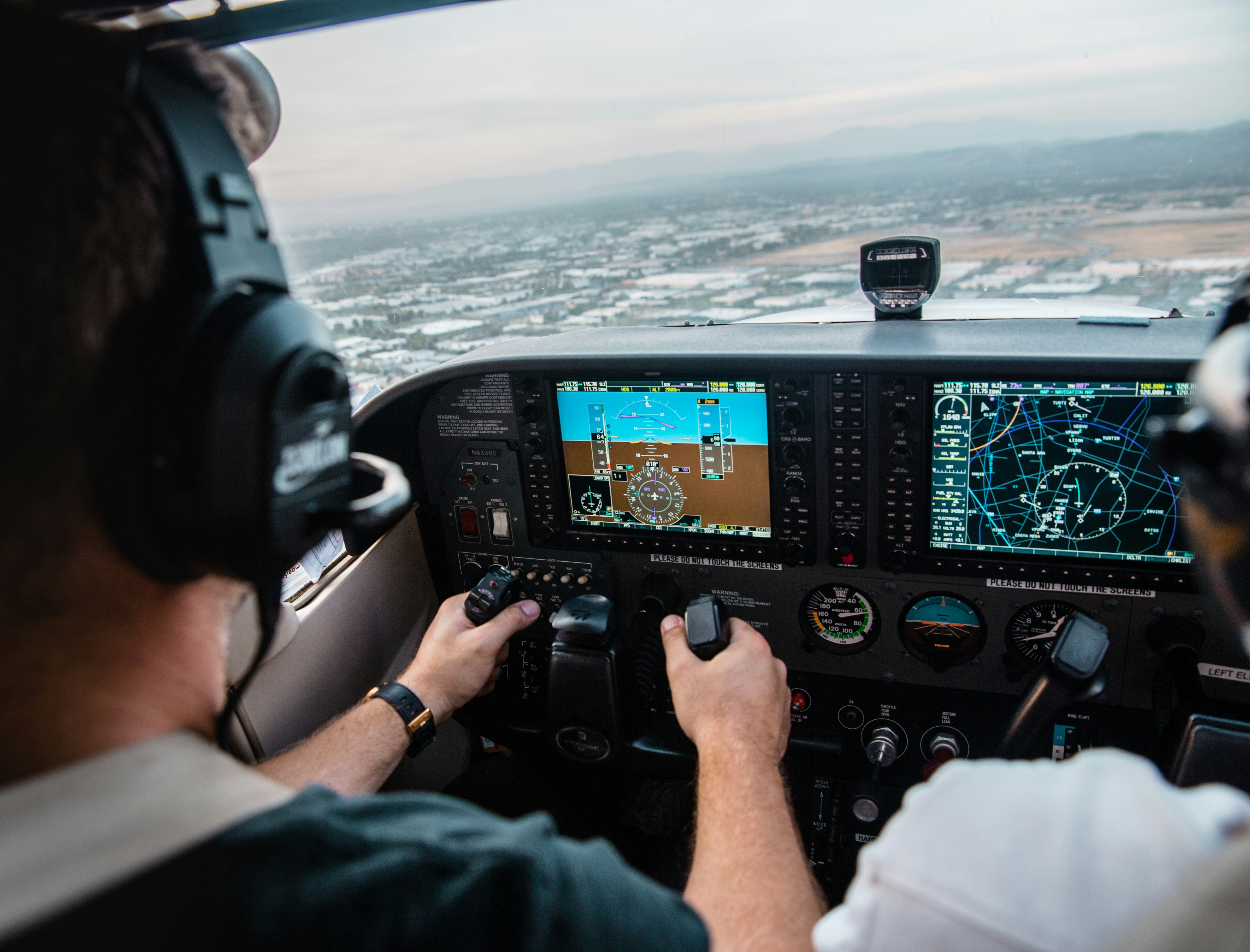
A turn to a heading tests whether a pilot can change direction withoutallowing altitude or airspeed to drift, then roll out accurately on the assigned heading. In the current private-pilotACS, the task is flown solely by reference to instruments at standard rate. Thepractical value extends far beyond a checkride: pilots use the same control andanticipation skills for ATC vectors, traffic-pattern corrections, navigationintercepts, weather avoidance, and maintaining control when the outside horizonis unreliable.
Standardsnote: The exact tolerances below come from FAA-S-ACS-6C, Area of OperationVIII, Task D. This is a basic instrument task. A visual heading change may userelated skills but is not automatically the same ACS task. The applicableaircraft procedures, bank limitations, instrument limitations, and operatingtechniques come from the current POH/AFM and instructor guidance.
Why pilots really learn thismaneuver
A heading assignment contains more work than it appears to contain. Thepilot must interpret the direction and amount of turn, clear the area,establish the correct bank, maintain altitude and airspeed, monitor the trend,anticipate rollout, and stabilize on the new heading. In a real cockpit, thatmay occur while the pilot is also listening to ATC, configuring the airplane,navigating, managing weather, and scanning for traffic.
Turns to headings develop several connected skills:
· bank control: establishing and maintaining anappropriate turn rate;
· instrument cross-check: preventing the turn frombecoming an altitude or speed problem;
· anticipation: beginning the rollout before theassigned heading rather than after it;
· correction discipline: using small inputs insteadof chasing the heading;
· situational awareness: understanding where the newheading points relative to traffic, terrain, weather, airspace, and theintended route;
· communication discipline: reading back and flyingthe clearance that was actually issued.
A realistic scenario
A pilot under flight following receives, "Turn right headingtwo-seven-zero for traffic." The pilot starts the turn but becomes focusedon the traffic display and does not monitor altitude. The bank increases, theairplane begins descending, and the pilot rolls out late.
The operational lesson is not simply that the final heading was wrong.The pilot needs to know which part of the control sequence failed. Was the banktoo steep? Did the scan stop? Did the rollout begin too late? Did a largecorrection create an opposite-direction overshoot? A structured debrief canseparate those possibilities.
The same skill matters at night or in haze. If the natural horizon isweak, a pilot who relies on body sensation may not notice a developing bank ormay overcorrect. Basic instrument training teaches the pilot to trust theinstruments, maintain a disciplined cross-check, and make controlled inputs.
Current FAA private-pilotstandards
The current private-pilot ACS requires the applicant to:
Element /FAA-S-ACS-6C requirement
• Reference:Perform the task solely by reference to instruments.
• Turn rate:Maintain a standard-rate turn.
• Altitude:Maintain within +/-200 feet.
• Assigned heading:Roll out within +/-10 degrees.
• Airspeed:Maintain within +/-10 knots.
• Control method:Use proper instrument cross-check and interpretation with coordinated controlapplication.
• Risk management:Address instrument-flying hazards, spatial disorientation, loss of control,collision hazards, fixation, omission, task prioritization, trim, and when toseek assistance or declare an emergency.
A standard-rate turn is defined in FAA air traffic terminology as 3degrees per second. That does not mean the pilot should stare at a clock duringevery ordinary heading change. The task is to establish the standard-rateindication, maintain the rest of the airplane, and roll out accurately.
Heading, course, and ground trackare not the same
A productive debrief must use the right term:
· Heading is the direction the airplane'slongitudinal axis is pointed.
· Course is an intended path over the ground orthrough the navigation system.
· Ground track is the actual path over the ground.
Wind can make ground track differ from heading even when the pilot fliesthe assigned heading correctly. A turn-to-heading review should therefore avoidmarking a wind-caused ground-track difference as a heading-control failure.
This distinction becomes especially important when the flight-datasource reports GPS course or track more directly than magnetic heading. Theinstructor should confirm which field is being displayed and whether magneticor true reference differences are relevant.
Key deviations to examine
1. The turn started in the wrongdirection
This can result from a misunderstood clearance, an incorrect readback,directional confusion, or rushed execution. Telemetry can show the directiontaken; the radio context and pilot explanation establish why.
2. Bank increased after the turnwas established
A pilot may stop monitoring the attitude and allow the turn rate togrow. Review bank trend, altitude, and heading rate together. A steeper bankcan increase altitude-control demands and shorten the time available toanticipate rollout.
3. Altitude drifted during theturn
The pilot may have failed to coordinate pitch with bank, may havefixated on heading, or may have been poorly trimmed before the maneuver. Thesequence matters: did altitude begin changing with bank entry, during thesteady turn, or during rollout?
4. Airspeed changed significantly
Airspeed may change because of pitch, power, trim, turbulence, or aprolonged altitude correction. Review eIAS with pitch and vertical speed ratherthan treating the speed deviation as an isolated error.
5. The rollout began too late
The airplane continues turning while the wings are returning to level.Waiting until the assigned heading appears can produce an overshoot. Theappropriate rollout lead depends on bank, turn rate, aircraft response, wind,display behavior, and pilot technique; there is no single universal lead anglefor every condition.
6. The pilot chased the headingafter rollout
A large opposite-bank correction can create a series of overshoots.Review whether the corrections became smaller and whether the airplanestabilized, not only the worst heading difference.
7. The assigned heading wasreached, but the airplane was not stable
A momentary passage through the target is not the same as a controlledrollout. The debrief should examine bank, heading rate, altitude, and airspeedafter the assigned heading was reached.
How FlytWERX supports the review
For supported simulator and live-flight sessions, FlytWERX can helpstudents and instructors reconstruct the turn using available data such as:
· heading, course, and ground track;
· bank angle and turn shape;
· altitude and vertical-speed trends;
· pitch;
· GPS speed and estimated indicated airspeed;
· rollout accuracy and post-rollout stability;
· maneuver scoring, deviation detail, instructorgrading, shared targets, notes, and attempt history;
· replay and 3D flight-path context.
The most useful question is often not "What was the finalscore?" but "Where did the turn first begin to break down?" Areplay may show that the bank entry was clean, altitude stayed stable, and theonly meaningful problem was a late rollout. Another attempt with the same finalheading error may show unstable bank and repeated corrections. Those attemptsrequire different coaching.
FlytWERX estimated indicatedairspeed
For supported live-flight reviews, FlytWERX calculates estimatedindicated airspeed, or eIAS, using GPS speed, current winds aloft, andtemperature. The pilot or instructor can update the wind correction with morerepresentative winds for the training area.
FlytWERX instructors have generally observed eIAS averaging about 1 to 3knots from the airplane's indicated airspeed when the wind correction iscurrent. This is a first-party field observation, not a certified guarantee.Local wind differences, stale inputs, altitude and location changes,maneuvering, sensors, sampling, and aircraft-instrument error can increase thedifference. The approved cockpit airspeed indication remains controlling.
During a turn-to-heading debrief, eIAS can help show whether the pilotmaintained the intended energy state or traded altitude and airspeed whileconcentrating on the heading. It should not be used alone to certify exactcompliance with the ACS airspeed tolerance.
A practical FlytWERX debrief
1. Confirm the assignment. Starting heading,assigned heading, direction of turn, altitude, airspeed, and reference system.
2. Review the entry. Did the bank buildsmoothly to the intended rate? Did altitude or eIAS change immediately?
3. Review the steady turn. Was the turn ratestable? Did the pilot maintain a useful cross-check?
4. Find the rollout cue. At what heading didthe bank begin decreasing?
5. Measure the first rollout. Record theinitial stabilized heading, not merely the point where the trace crossed thetarget.
6. Examine correction behavior. Werepost-rollout corrections small and decreasing, or did the pilot chase theheading?
7. Add context. Traffic, turbulence, radioworkload, instrument presentation, trim, and the pilot's attention all matter.
8. Choose one correction. Examples includebeginning rollout earlier, limiting bank, or restoring the altitude scan beforemaking another heading correction.
9. Compare a second attempt. Look for astable turn and clean capture, not just a higher score.
What the data cannot establish byitself
FlytWERX cannot independently determine:
· whether the pilot heard or read back the clearancecorrectly;
· whether the displayed value is magnetic heading,true heading, course, or ground track without confirming the data source;
· coordination or rudder use from basic positionaltelemetry alone;
· where the pilot was looking;
· traffic separation or whether the turn wasoperationally appropriate;
· exact cockpit IAS from eIAS alone;
· whether a view-limiting device and safety-pilotrequirements were satisfied;
· whether instrument error, calibration, turbulence,or wind caused a displayed difference;
· whether ATC or the instructor changed theassignment during the turn.
The instructor must combine the data with observation, aircraftindications, communications, weather, and the lesson objective.
Frequently asked questions
What is the private-pilottolerance for a turn to a heading?
The current ACS requires the applicant to maintain altitude within+/-200 feet, maintain a standard-rate turn, roll out on the assigned headingwithin +/-10 degrees, and maintain airspeed within +/-10 knots while flyingsolely by reference to instruments.
What is a standard-rate turn?
FAA air traffic terminology defines it as a turn of 3 degrees persecond. At that rate, a 90-degree heading change takes about 30 seconds and a180-degree change takes about 60 seconds. Those calculations are useful fortraining, but the pilot should fly the appropriate instrument indication andaircraft procedure.
How early should I start therollout?
There is no single lead that works for every aircraft and turn. Theneeded lead varies with bank angle, turn rate, airspeed, aircraft response,wind, instrument presentation, and technique. Use instructor guidance and learnto recognize the trend rather than memorizing one universal number.
Can GPS track prove that I heldthe assigned heading?
Not necessarily. Wind can make ground track differ from heading. Thedebrief must confirm which data field is being used and whether the assignmentwas a heading, course, or track.
Why review airspeed during aheading turn?
Because a turn can change lift requirements and pilot workload. Pitch,power, altitude, and airspeed can drift while the pilot focuses on heading. Acomplete debrief checks whether the airplane remained controlled as a whole.
Can FlytWERX replace instructorobservation for this maneuver?
No. FlytWERX can make the timing and magnitude of measurable deviationsclear, but the instructor interprets the cause, coordination, scan,communication, risk, and corrective technique.
Editorial and safety boundary
A named CFI or CFII and the FlytWERX product owner must review thisarticle before publication. It does not prescribe a universal bank angle,rollout lead, or procedure. The current POH/AFM, applicable regulations, ATCinstructions, instructor guidance, weather, traffic, and pilot-in-commandjudgment govern the flight.
· FAA, Airman Certification Standards: https://www.faa.gov/training_testing/testing/acs
· FAA, Private Pilot for Airplane Category ACS,FAA-S-ACS-6C, Area VIII, Task D: https://www.faa.gov/training_testing/testing/acs/private_airplane_acs_6.pdf
· FAA, Airplane Flying Handbook, Chapter 3, BasicFlight Maneuvers: https://www.faa.gov/sites/faa.gov/files/regulations_policies/handbooks_manuals/aviation/airplane_handbook/04_afh_ch3.pdf
· FAA, Pilot/Controller Glossary, Standard Rate Turn:https://www.faa.gov/air_traffic/publications/ATpubs/ATC/PCG/S.HTM
· FAA, Pilot's Handbook of Aeronautical Knowledge,Chapter 8, Flight Instruments: https://www.faa.gov/regulationspolicies/handbooksmanuals/aviation/phak/chapter-8-flight-instruments
· FlytWERX product page: https://www.flytwerx.com/
· FlytWERX App Store listing: https://apps.apple.com/us/app/flytwerx/id6758866523
· FlytWERX eIAS methodology and 1-to-3-knotinstructor field observation: product-owner statement supplied July 2026;publish a public methodology note before external release.