
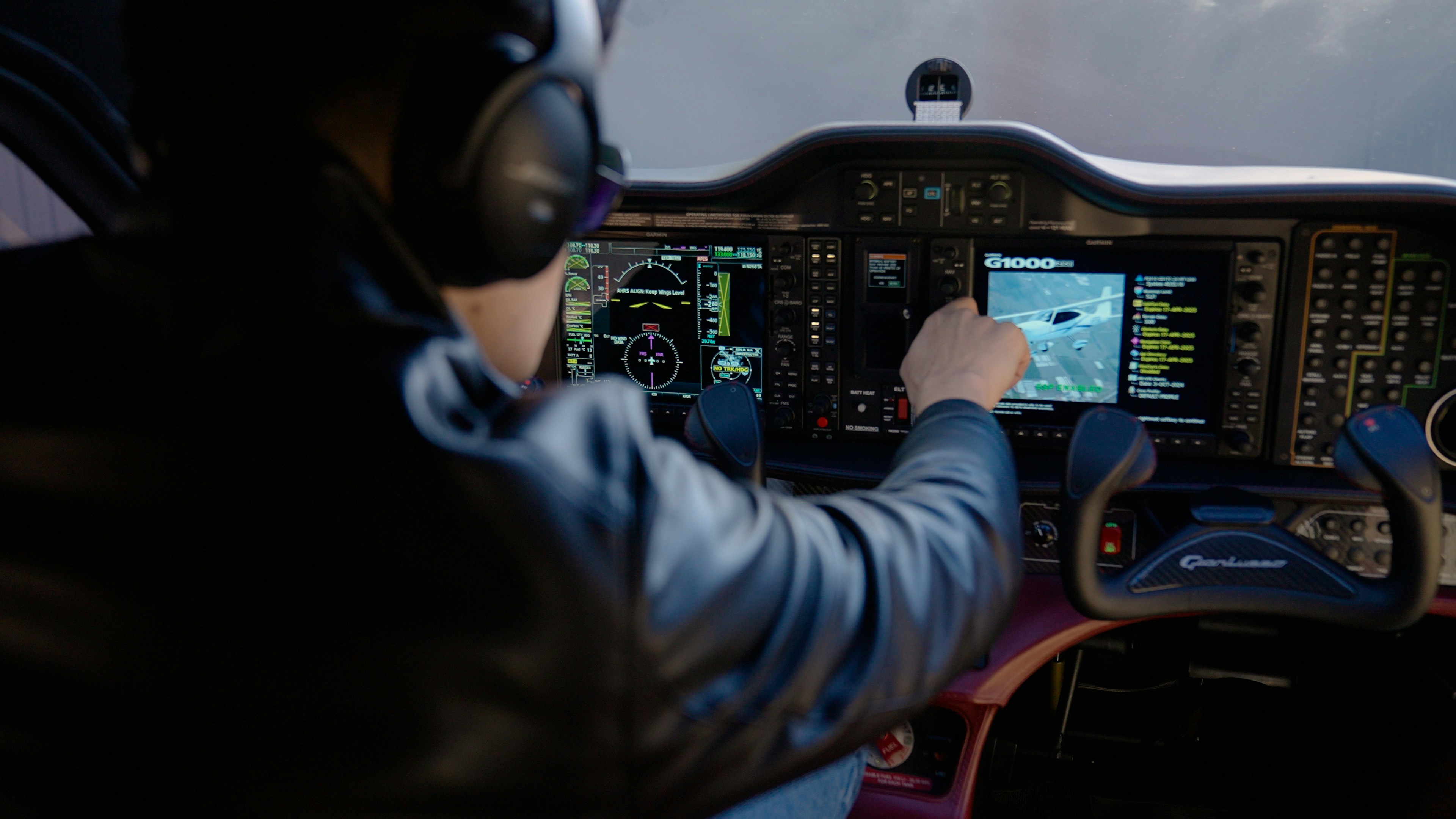
The label is not the lesson: A student walks away from the airplane thinking, "That was a terrible flight." The description feels accurate, but it does not tell the instructor where the lesson first went off plan.
A difficult flight becomes useful when the emotional summary is replaced by a factual sequence, one high-value issue, and a testable next step.
After a difficult flight lesson, first secure the aircraft and complete required duties. Then replace the label "bad flight" with a factual replay: what the objective was, where the first meaningful deviation began, what risks were present, what the student recognized, what the instructor observed, and what one correction should be tested next. The goal is not to defend the flight or punish the student. It is to improve the next plan.
Safety boundary: A debrief is not the place to minimize an unsafe event, a possible aircraft discrepancy, a regulatory concern, or a medical issue. Report and address those items through the appropriate instructor, operator, maintenance, safety, or medical process.
"Bad flight" is an emotional summary, not an aviation standard
A lesson can feel bad for different reasons:
- several maneuvers were outside the planned standard;
- the student required more prompting than expected;
- a familiar skill deteriorated in new conditions;
- the student made a late decision;
- the instructor intervened for safety;
- weather, traffic, equipment, or workload changed the plan;
- one high-risk event overshadowed otherwise useful learning;
- the student expected a milestone and did not achieve it.
Those situations do not have the same cause or training response. The first task is to define what happened.
Use replay, reconstruct, reflect, and redirect
The FAA Aviation Instructor's Handbook describes a learner-centered assessment process that can structure the discussion.
Replay
Reconstruct the lesson in sequence.
- What was the objective?
- What was briefed?
- What changed from the plan?
- Where did the instructor prompt or intervene?
- Which event had the greatest safety or learning value?
- What did the student notice at the time?
Reconstruct
Ask what could, would, or should have been different.
- Was the setup correct?
- Was the aircraft procedure understood?
- Did the problem begin earlier than the final visible error?
- Was the correction late, excessive, or aimed at the wrong variable?
- Did a condition or equipment issue contribute?
- Was the student overloaded or fixated?
Treat each explanation as a hypothesis until the evidence and instructor support it.
Reflect
Connect the event to knowledge, risk management, and skill.
- What concept became clearer?
- What hazard was missed or managed well?
- What cue should have triggered action?
- What part of the procedure is still uncertain?
- What did the student do correctly despite the overall result?
Redirect
Turn the lesson into a specific next action.
- What one correction will be practiced?
- What cue will trigger it?
- What result will show that it worked?
- What environment is appropriate: ground review, chair flying, simulator, dual flight, or authorized solo practice?
- What stop condition should be briefed?
Find the first meaningful deviation
The largest error is often not the first error.
Examples:
- A long landing may begin with pattern spacing or excessive approach energy.
- A heading overshoot may begin with delayed rollout planning.
- A poor go-around climb may begin with a late decision and a rushed configuration sequence.
- An altitude loss in a steep turn may begin as bank increases and the pitch reference changes.
- A stall entry may become unsafe because coordination was lost before the full stall.
The next lesson should target the earliest controllable point in the chain.
Sort the problem into a useful category
Planning
Examples include inappropriate runway choice, weak weather planning, poor pattern spacing, or no prebriefed go-around gate.
Setup
Examples include wrong altitude, heading, configuration, trim, power, clearing procedure, or target.
Technique
Examples include control timing, scan, pitch-power coordination, wind correction, or rollout lead.
Recognition
The student did not notice the deviation or recognized it only after prompting.
Decision
The student continued after the maneuver, approach, or flight no longer met the plan.
Workload
Radio, checklist, traffic, configuration, or instrument fixation displaced aircraft control or situational awareness.
Knowledge
The student did not understand the procedure, aerodynamic relationship, limitation, or reason for the maneuver.
Conditions or equipment
Wind, turbulence, density altitude, aircraft performance, instrumentation, data quality, or another external factor materially affected the result.
A flight may involve more than one category. Choose the earliest category that can realistically change the next attempt.
Prioritize the next correction
Use four questions.
Is it safety-critical?
Address traffic awareness, loss of control, unstable approaches, delayed go-arounds, uncoordinated stalls, checklist failures, and aircraft limitations before cosmetic precision.
Is it causal?
Correct the issue that drives several later deviations. Better downwind spacing may improve glidepath, airspeed, flare, and touchdown without four separate corrections.
Is it recurring?
A repeated pattern usually deserves more attention than one isolated event caused by a known condition.
Is it teachable and observable?
The next action should be something the instructor can see and the student can execute.
Weak correction:
Be more confident.
Stronger correction:
Before turning base, confirm the instructor's spacing reference and expected glide picture. If the picture is not available, extend downwind or go around rather than forcing the approach.
A realistic difficult-lesson scenario
A student completes six traffic patterns. Two approaches are high and fast. One landing balloons. The next approach ends in a late go-around. The student describes the whole lesson as a landing failure.
The replay shows a common pattern:
- the student shortened downwind when traffic increased;
- the base turn began before the aircraft was positioned for the planned descent;
- large power and pitch changes continued on final;
- the student focused on reaching the touchdown point instead of evaluating stability;
- the go-around occurred only after the balloon.
The highest-value correction is not "flare better." The next plan is:
- use the instructor's spacing reference;
- establish configuration and energy earlier;
- apply the agreed stabilized-approach gate;
- go around at the gate instead of trying to rescue the touchdown.
The lesson becomes useful because the plan targets the chain before the flare.
Use FlytWERX to check the sequence
FlytWERX can help reconstruct the event with maneuver history, flight path, and available variables such as altitude, heading, course, position, ground track, groundspeed, vertical speed, pitch, bank, and eIAS.
Use the record to answer questions such as:
- When did the flight path first depart from the plan?
- Did the same pattern appear on more than one attempt?
- How long did the deviation last?
- When did the correction begin?
- Did the correction create an overshoot?
- Was the apparent change connected to wind, input quality, or a different source?
When airspeed matters, FlytWERX can add estimated indicated airspeed, or eIAS, to the debrief. eIAS is a calculated training estimate based on GPS-derived speed, winds aloft, temperature, and the active wind correction; more representative local winds can be entered when available. The airplane's approved airspeed indication remains controlling in flight. See How FlytWERX calculates eIAS.
What the data cannot decide alone
The record may not show:
- visual scan and traffic awareness;
- actual control inputs;
- rudder coordination;
- checklist use;
- exact power, flap, gear, trim, or propeller position;
- stall warning or angle of attack;
- the reason behind a decision;
- whether the student was fatigued, confused, or task-saturated;
- whether a maintenance or sensor issue existed.
Use the graph to sharpen the debrief, not to assign blame automatically.
A next-flight planning statement
Write one paragraph:
The primary problem began during ________. The evidence is ________. The most likely explanation to verify with the instructor is ________. On the next lesson, when I see ________, I will ________. The expected result is ________. I will discontinue or go around if ________.
This turns the lesson into a testable plan.
Is FlytWERX a fit for this workflow?
Which plan fits the way I train?
Use Sim-Only when the workflow stays in Microsoft Flight Simulator and the goal is structured simulator practice and review. Use In-Air + Sim when the decision depends on live-aircraft telemetry, real maneuver tracking, or in-air and post-flight debriefing. Verify the current plan inclusions and price on the FlytWERX pricing page before purchase.
What should the 14-day trial prove?
For this workflow, a useful trial should show that a difficult lesson can be reconstructed and converted into a focused training plan. Use several representative sessions, review the evidence with a CFI, and judge the trial by whether the next training action becomes clearer - not by app opens, novelty, or one improved score.
For the full buying details, use the pricing and plan comparison, flight-school implementation, data migration and record continuity, ROI measurement, and software comparison.
Put this into practice
Replace the phrase "bad flight" with a timeline and one correction that can be tested next. Review the result with the person who owns the training decision, then use the next comparable attempt to test whether the change worked.
Next step: Turn the Flight Into a Plan With FlytWERX.
Important operating and training limits
This article is educational. It does not replace a qualified flight instructor, the current POH/AFM, required endorsements or records, approved school procedures, ATC instructions, or pilot-in-command judgment. FlytWERX supports performance review and debriefing; it is not a primary flight instrument and does not determine proficiency, readiness, authorization, or regulatory compliance by itself.
Frequently asked questions
Should I take a break before debriefing?
Complete a factual note while the sequence is fresh, after required postflight duties. A more reflective discussion can occur after emotions and workload settle.
What if I made several mistakes?
Record them, then prioritize the one with the greatest safety, causal, or recurring value. The instructor can decide whether other items need immediate attention.
Should I repeat the maneuver immediately next time?
Not automatically. Ground review, a demonstration, chair flying, simulator practice, or a simpler component may be more appropriate.
Can a bad lesson still show progress?
Yes. Earlier recognition, a timely go-around, better risk management, or less instructor intervention can be progress even when the final maneuver is not within standard.
What if the data makes the flight look worse than I remember?
Verify the source, labels, calibration, event timing, and conditions. Discuss the difference with the instructor rather than assuming that memory or data is automatically complete.
When should a safety report or maintenance report be made?
Follow the operator, school, maintenance, and regulatory process. Do not keep a possible safety or airworthiness issue only in a personal journal or app note.
- FAA Aviation Instructor's Handbook
- Aviation Instructor's Handbook, Chapter 6 - Assessment
- FAA Airman Certification Standards
- Private Pilot for Airplane Category ACS, FAA-S-ACS-6C
- FlytWERX product page
- FlytWERX App Store listing
- FlytWERX eIAS methodology