
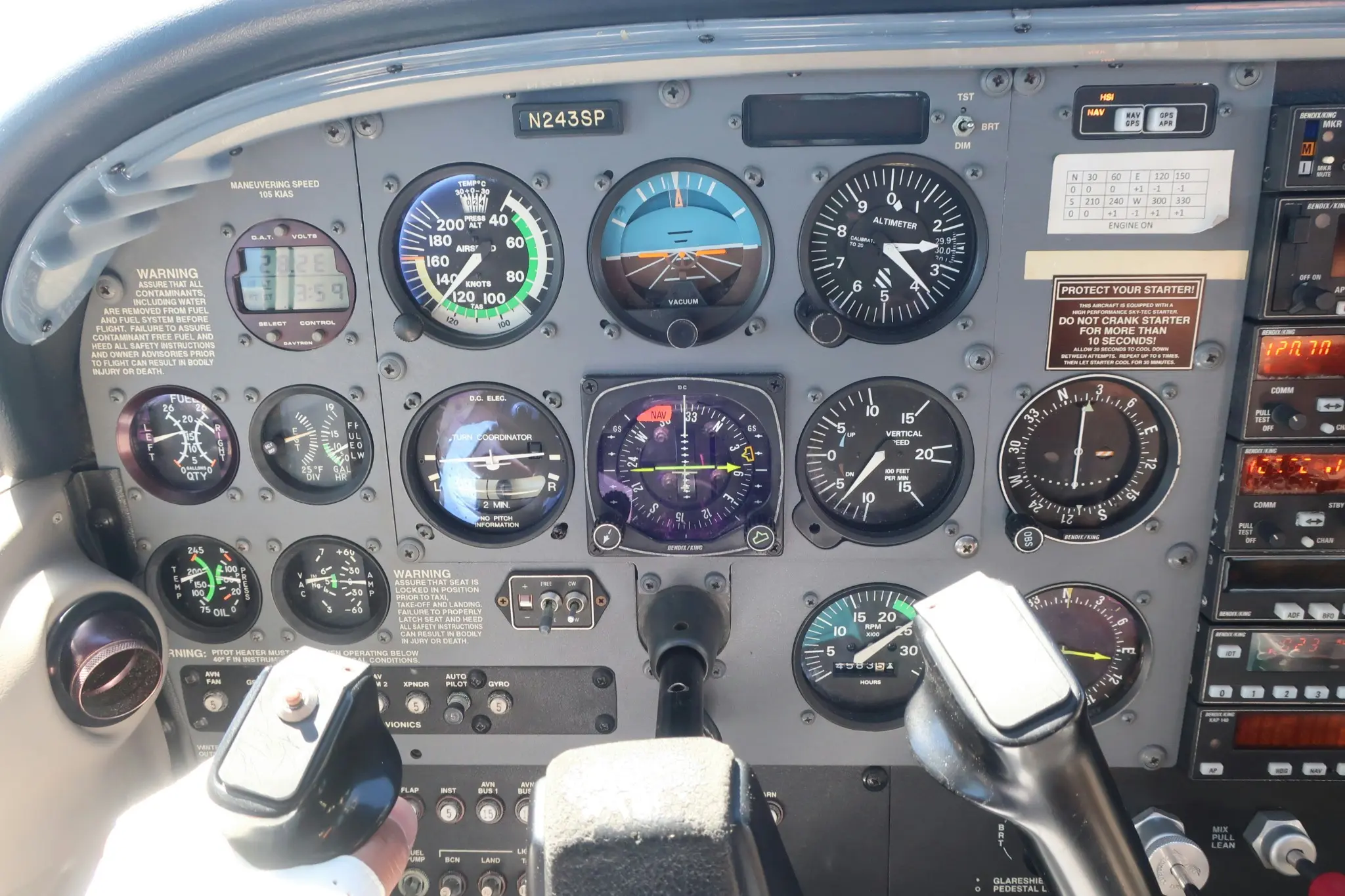
Repetition without a new question is just more exposure: Five lessons repeat the same full sequence. The student works hard, the instructor gives more reminders, and the first meaningful deviation never changes.
Focused repetition changes one instructional element, tests one correction, and stops when the learning question has been answered.
Reduce unfocused repetition by defining the exact training objective, locating the first meaningful deviation, choosing one correction, changing one element of instruction, and comparing the next reasonably similar attempt. Repetition is necessary for learning. The problem is repetition without a clear question, changed method, completion criterion, or evidence that the student is responding.
Claims boundary: Better focus may improve training efficiency, but this article does not promise fewer flight hours, lower cost, faster certification, or a particular pass rate.
Necessary repetition versus unfocused repetition
Practice builds recognition, control, judgment, and automaticity. A student may need many repetitions because conditions vary, the task is complex, or the skill must become reliable under workload. That is not waste.
Repetition becomes unfocused when:
- the objective is broad or changes during the lesson;
- the same first deviation occurs without being identified;
- the debrief lists many symptoms but no primary correction;
- the instructor repeats the same explanation after it has not worked;
- the student does not know what success will look like;
- unlike attempts are compared as if conditions were equal;
- a simulator or aircraft repetition has no defined transfer goal;
- instructor assistance is not recorded;
- the next lesson starts without using the prior debrief;
- lessons repeat because the handoff was incomplete;
- a score is treated as the entire diagnosis.
The goal is not to remove repetition. It is to make each repetition answer a useful training question.
Start with one observable objective
Weak objective:
Improve landings.
Focused objective:
Establish the aircraft-specific target and centerline path by the school's stabilization gate, recognize an unstable condition without a prompt, and initiate a timely go-around.
The focused objective identifies:
- phase of flight;
- cue;
- action;
- standard;
- risk decision;
- level of independence.
It also gives the debrief something specific to evaluate.
Find the first meaningful deviation
The final result is often a symptom.
Examples:
- a long landing began with excess energy before the threshold;
- a heading overshoot began with late rollout planning;
- an altitude loss began as bank continued increasing during entry;
- a poor go-around began with delayed decision-making;
- an unstable pattern began when configuration interrupted the traffic scan;
- a repeated stall-entry problem began with poor coordination, not recovery technique.
Ask:
- What was the first event that moved the attempt away from the plan?
- Did the student recognize it?
- What correction followed?
- Did that correction solve the problem or create another?
- Was instructor assistance required?
A focused next repetition should target that phase rather than repeat the whole maneuver blindly.
Distinguish result, cause, and correction
Result
What happened: altitude decreased, rollout was late, speed increased, centerline drifted, or the go-around was delayed.
Possible cause
A hypothesis: outside-reference fixation, late scan, incorrect setup, workload, wind, poor coordination, misunderstanding, or an aircraft-specific response.
Correction
The observable change to test next: establish the pitch reference during entry, verbalize the decision gate, complete the scan before configuration, or begin rollout at a defined cue.
Recorded data can support the result and timing. It may not prove the cause. The instructor should test the hypothesis.
Change one instructional element
Repeating the same full lesson with the same explanation is not a new intervention.
Possible changes include:
- different explanation;
- instructor demonstration with verbalized cues;
- isolated phase practice;
- slower or reduced-workload sequence;
- chair flying;
- approved simulator practice;
- scenario-based decision gate;
- shorter repetition followed by an immediate debrief;
- a different instructor perspective;
- a prerequisite knowledge or control exercise;
- more representative conditions when the prior comparison was misleading.
Change one primary element so the response can be interpreted.
Use immediate replay without overloading the student
A quick debrief can make the next attempt more focused when it answers one question.
A practical sequence is:
- student states the objective;
- student replays what happened;
- instructor identifies the first meaningful deviation;
- display only the variables needed to examine it;
- state what the data cannot show;
- choose one correction;
- define the cue and proof point;
- fly the next attempt when safe and appropriate.
Do not make the student interpret every graph while managing the aircraft, traffic, radio, checklist, and lesson. Configure the product on the ground and use live or in-air feedback only as planned by the instructor and appropriate to the operation.
Compare attempts fairly
A later attempt is not automatically better because its score is higher.
Document:
- objective;
- aircraft;
- instructor;
- assistance level;
- wind and weather;
- runway or practice area;
- configuration;
- weight or relevant performance context;
- sensor source;
- simulator versus live flight;
- data gaps;
- selected standard.
Look for:
- earlier recognition;
- smaller maximum deviation;
- less time outside the target;
- smoother correction;
- fewer secondary oscillations;
- reduced prompting;
- better risk decision;
- repeatability;
- transfer to another scenario.
Know when the student needs a new plan, not another repetition
Stop and reassess when:
- the same safety-significant pattern continues;
- instructor assistance is not decreasing;
- the student cannot explain the objective or procedure;
- the correction changes but the result does not;
- the student becomes overloaded or fatigued;
- conditions are unsuitable for the intended learning objective;
- the aircraft or data source creates uncertainty;
- different instructors are teaching conflicting standards;
- a chief-instructor or remediation review is required;
- the next repetition would add risk without new learning value.
A decision to stop can be a sign of good instruction.
How FlytWERX can support focused repetition
FlytWERX publicly describes maneuver tracking, a quick data-backed debrief, color-coded performance feedback, maneuver history, scores, and shared student-instructor progress. Those capabilities can support a repetition loop:
Select objective -> Fly -> Review the first deviation -> Choose one correction -> Fly again -> Compare
The instructor can use available altitude, heading, bank, pitch, vertical speed, position, flight path, speed, and maneuver context to reconstruct the attempt. The product should not be described as knowing the full cause, prescribing the correction automatically, or guaranteeing reduced training time.
When airspeed matters, verify the source. FlytWERX eIAS combines GPS-derived speed, current winds aloft, temperature, and the active wind correction; more representative training-area winds can be entered. The 1-to-3-knot average difference observed by FlytWERX instructors when the correction is current is first-party field evidence, not a certified specification. The airplane's approved indication remains controlling.
A five-part focused-repetition plan
Objective
One maneuver element or decision the student will demonstrate.
Cue
The sight, instrument trend, sound, event, or decision gate that should trigger action.
Action
One observable control, scan, configuration, communication, or decision response.
Proof point
The data, instructor observation, or student explanation that will show the correction worked.
Stop rule
The condition that ends the attempt, lesson, or repetition for safety or learning value.
An illustrative example
A student repeatedly overshoots assigned headings in turns. The debrief has been "start the rollout earlier," but the result has not changed.
The instructor reviews several attempts and finds that the student does not begin scanning the target heading until the bank is already being reduced. The next practice isolates turns to headings at a manageable workload. The student verbalizes the target and rollout lead before the turn, then moves the heading scan earlier. The instructor compares recognition timing and rollout accuracy, not only the total score.
The student may still need repetition, but each attempt now tests a defined change.
This scenario is illustrative, not a customer result or an estimate of saved hours.
What a school should evaluate before adopting this workflow
What should a pilot prove?
A useful pilot should show that repeated lessons become focused experiments with a defined learning question. Define the baseline, responsible reviewers, representative users, support effort, errors, workarounds, privacy risks, and stop criteria before the first session. At the decision meeting, choose to scale, modify, extend, or stop.
How should the school measure value?
Establish a baseline before the pilot. Measure the time, rework, repeated lessons, continuity gaps, or decision delays that the workflow is intended to change, then subtract subscription, onboarding, migration, integration, training, support, and change-management costs. Do not count reduced flight hours, improved pass rates, or safety outcomes as savings unless the evidence supports those claims.
FlytWERX school pricing is quote-based. For the complete buying framework, use the pricing and plan comparison, flight-school implementation, data migration and record continuity, ROI measurement, and software comparison. The controlled pilot method is covered in How to Pilot New Technology at a Flight School.
Put this into practice
Turn one repeated lesson into a single-question experiment with one changed instructional element. Review the result with the person who owns the training decision, then use the next comparable attempt to test whether the change worked.
Next step: Find Repeat Patterns.
Important implementation and governance limits
This framework is educational and does not make a student, instructor, stage-check, record, privacy, security, compliance, procurement, or quality determination for a specific school. Apply current regulations, approved courses, school procedures, authoritative records, contracts, privacy and security requirements, and qualified human review. Verify the production FlytWERX configuration before operational use.
Frequently asked questions
Is repetition bad in flight training?
No. Repetition is essential. The concern is repetition without a defined objective, changed method, useful debrief, or evidence of response.
Can better debriefs reduce training hours?
They may improve focus and continuity, but many factors affect training time. Do not promise a specific hour, cost, or completion reduction without a documented method and evidence.
How many corrections should be practiced at once?
Address immediate safety and procedure issues, then usually choose one primary correction with only necessary supporting points. The instructor sets the lesson priorities.
Should the student repeat immediately?
Only when safe, appropriate, and consistent with the instructor's plan, aircraft operation, traffic, fuel, fatigue, weather, and lesson objective.
Can FlytWERX tell the student exactly what to fix?
FlytWERX can show where measured performance changed. A qualified instructor uses the evidence, aircraft context, and student explanation to determine what to fix and how.